
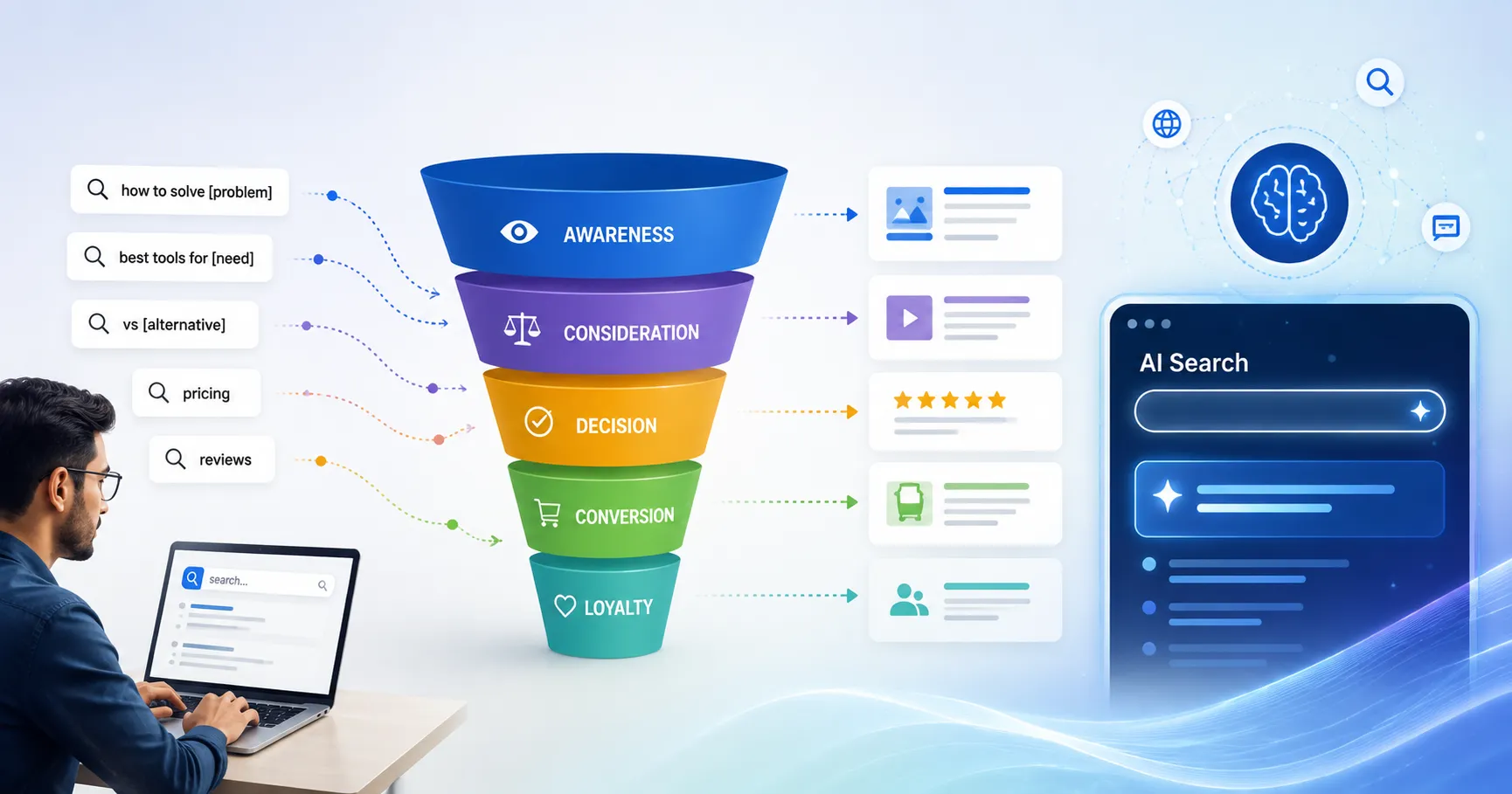
🗺️ What is Customer Journey SEO and why does it matter in 2026? (Direct answer)
Customer Journey SEO is the practice of mapping every SEO investment (keywords, content formats, internal linking and conversion signals) to a specific stage of the buyer's journey. It recognises that a user searching "what is marketing automation" is at a completely different purchase stage than someone searching "HubSpot vs Marketo pricing." The three-stage TOFU / MOFU / BOFU framework (Top, Middle, Bottom of Funnel) provides the structure: TOFU captures awareness with educational guides; MOFU serves consideration with comparisons and case studies; BOFU converts with trial, demo and pricing pages. In 2026 the framework has to account for AI answers too. SparkToro's June 2026 study found that 68% of US Google searches in early 2026 ended without a click, so awareness content has to earn value even when the click doesn't come, while MOFU and BOFU pages, where people still have to visit a site to act, deserve proportionally more attention.
Informational intent: "What is…", "How does…", "Guide to…"
Wide audience, no purchase intent yet. Goal: establish topical authority, capture brand impressions, earn AI Overview citations. Content: pillar guides, explainers, comparison overviews, glossary entries. Metrics: impressions, scroll depth, newsletter signups, AI citation mentions.
Commercial investigation: "Best…", "X vs Y", "Alternatives to…", "Reviews"
Narrowing audience actively evaluating options. Goal: become the recommended solution in their consideration set. Content: comparison articles, use-case guides, case studies, ROI calculators, template libraries. Metrics: pages per session, comparison page engagement, lead form submissions.
Transactional intent: "Pricing", "Free trial", "Demo", "[Brand] + use case"
Small, high-intent audience ready to act. Goal: remove friction, answer final objections, convert. Content: pricing pages, demo/trial landing pages, testimonial pages, objection-handling FAQs, ROI calculators. Metrics: organic sessions to conversion, revenue per organic session, assisted conversion value.
AI Overviews, AI Mode, ChatGPT Search, Perplexity: new citation battleground
AI search surfaces probably affect TOFU most (informational answers), MOFU moderately (recommendations) and BOFU least (current pricing, sign-up). That split is my reading of how these queries behave, not a published measurement. Google says there is no special markup for these features, so the work is clear direct answers, named sources and cited data. Track AI mentions alongside GSC data.
What Is Mine and What Is Cited
This is the complete guide to Customer Journey SEO, TOFU/MOFU/BOFU mapped to intent, content, and AI search signals. For related deep dives:
- Topical authority clusters that power the funnel: Topical Authority & Pillar Pages Guide →
- E-E-A-T signals required across all funnel stages: E-E-A-T & Brand Authority Guide →
- AI Overview optimisation (GEO) for TOFU & MOFU: GEO & AEO Complete Guide →
- GSC and GA4 measurement: Google Search Console Complete Guide →
- TOFU / MOFU / BOFU maps search intent directly to buyer stage: informational (awareness) → commercial investigation (consideration) → transactional (conversion). Each stage needs different content formats, CTAs, and success metrics.
- The MOFU gap is the most common and highest-impact content gap, sites with strong TOFU coverage but no comparison, use-case, or review content lose users to competitor sites at the evaluation stage. Fixing it drove a 34% increase in organic leads in one direct client engagement.
- AI answers probably hit TOFU hardest (informational queries are where an answer can satisfy the searcher) and BOFU least (people still have to visit to buy). The response: make TOFU pages worth citing and worth the click, and invest proportionally more in MOFU. Google says no special markup is needed for AI features.
- Internal linking is funnel architecture: every TOFU page must contextually link to MOFU pages; every MOFU page must link to BOFU conversion pages. Without this, users exit to Google to continue their research, and find your competitors.
- Last-click attribution hides TOFU's value. In one B2B SaaS GA4 analysis, 41% of organic trial signups had a TOFU page in their conversion path, invisible under last-click. Use GA4 data-driven attribution and Funnel Exploration to measure the full path.
- Be careful with AI-citation shortcuts. Google says there is no special schema, llms.txt or AI text file for its AI features, and FAQ rich results stopped showing in May 2026. Clear answers, named authors and cited data are the durable part.
1. What Is Customer Journey SEO?
Customer Journey SEO is a strategic framework that aligns every SEO decision, keyword selection, content type, page structure, internal linking, CTAs, and conversion signals, with the stage of the buyer journey the target user is actually in. It rejects the legacy model of treating all keywords as equivalent ranking targets and instead maps search queries to the user state behind them: Are they just learning? Actively comparing options? Ready to buy?
The core insight is that the same product category generates entirely different searches at each stage of the decision process. A user buying project management software might search "what is project management software" (TOFU, pure learning), then "Monday.com vs Asana comparison" (MOFU, active evaluation), then "Monday.com pricing plans 2026" (BOFU, purchase imminent). Each of these three searches requires a completely different page, a completely different content format, and completely different success metrics. Optimising a pricing page for an informational query, or writing an educational guide for someone ready to buy, wastes both content investment and SEO resource.
In 2026, the customer journey SEO framework has a new dimension: AI search. Google AI Overviews and AI Mode now generate synthesised answers in the results for many informational queries, which can reduce clicks to individual sites. TOFU therefore needs two jobs: rank for the query and give an answer clear enough to be quoted. Google's own guidance on generative AI features calls this still SEO. See the GEO & AEO Guide for the AI citation framework, and Google AI Mode SEO Guide 2026 for how AI Mode changes results pages.
2. The Four Search Intent Types and Funnel Mapping
The standard way to read search intent is a four-part taxonomy (Informational, Navigational, Commercial Investigation and Transactional) used by tools such as Semrush. Google doesn't publish its own intent classification, but the four types map neatly onto funnel stages, which makes them a sound base for keyword strategy.
| Intent Type | Funnel Stage | Query Examples | SERP Signals | Content Goal |
|---|---|---|---|---|
| Informational | TOFU | "What is SEO," "How does email marketing work," "Guide to content strategy" | Long-form guides, Wikipedia, explainer videos, AI Overviews | Build awareness, establish topical authority, earn AI citations |
| Commercial Investigation | MOFU | "Best email marketing tools 2026," "Mailchimp vs Klaviyo," "Alternatives to HubSpot" | Comparison articles, listicles, review sites (G2, Capterra), case studies | Enter consideration set, demonstrate differentiators, generate leads |
| Transactional | BOFU | "Buy Klaviyo plan," "Klaviyo pricing," "Klaviyo free trial sign up" | Brand sites, product pages, PPC ads, transactional landing pages | Convert: trial, demo, purchase, signup |
| Navigational | Any: typically BOFU re-entry | "Klaviyo login," "HubSpot support," "[Brand] dashboard" | Brand's own site dominates; Knowledge Panel | Ensure brand owns navigational queries; defend against competitor targeting |
3. TOFU SEO: Awareness Stage Strategy
TOFU content is the widest part of the funnel, reaching the largest audience but at the lowest purchase intent. Its primary SEO purpose is to establish topical authority: demonstrating to both Google and potential customers that your site is the authoritative resource on the subject domain your product or service addresses. Secondary purpose in 2026: positioning your content to be cited within AI Overviews and AI Mode responses, extending reach even as zero-click rates rise.
For a B2B project management software company: "What Is Project Management? A Complete Guide," "The 7 Phases of a Project Lifecycle," "What Is a Gantt Chart and How Do You Use One?", "Project Management Methodologies Explained: Agile, Waterfall, Scrum, Kanban." These educate the broadest possible audience, anyone who might ever need project management software, without pitching the product. The pitch comes later, through internal links to MOFU and BOFU pages.
Identify TOFU queries by their modifiers: "what is," "how does," "how to," "what are," "guide to," "explained," "definition," "examples of," "types of," "overview of," "tutorial." Also look for broad category terms without brand or action modifiers, "email marketing," "content strategy," "SEO basics." In GSC, filter by queries containing these modifiers to segment your existing TOFU traffic and identify gaps in coverage.
TOFU content should not be measured by direct conversions, that misrepresents its function. The right TOFU metrics: organic impressions (reach), average position on TOFU queries, scroll depth (do users actually read?), return visit rate (did awareness stick?), AI Overview citation mentions (are you being cited?), and newsletter/email capture conversions. Use GA4 attribution to track the proportion of eventual BOFU conversions that had a TOFU page as a touchpoint in their path.
4. MOFU SEO: Consideration Stage Strategy
MOFU is where the SEO funnel starts generating measurable pipeline. Users at this stage have moved from learning what a category is to actively comparing specific solutions. The intent signals are commercial investigation: they are building a consideration set, defining evaluation criteria, and reading reviews and comparisons to narrow their options. This is where your specific product or service needs to appear: not just your educational content.
In Q4 2024, I conducted a full-funnel SEO audit for a mid-market B2B SaaS client with approximately 80,000 monthly organic sessions. Their content library had 120+ TOFU articles covering "what is" and "guide to" questions, but only 8 MOFU comparison and review pages. Their organic funnel had a massive awareness layer and almost no consideration layer: users who found them via TOFU content had nowhere to go on-site when they reached the evaluation stage, so they navigated away to competitor comparison sites instead.
After building 22 targeted MOFU pages, "[Product] vs [Competitor]" comparison pages, "[Product] for [industry]" use-case guides, and a comprehensive feature comparison matrix, organic lead generation from SEO increased 34% within 6 months. The TOFU traffic didn't increase meaningfully; the MOFU architecture simply captured a much higher proportion of the existing audience at the right intent stage. MOFU content had the highest ROI of any content investment in this engagement. — Rohit Kunal
The highest-performing MOFU content types in 2026 are: (1) Direct comparison pages: "[Your Product] vs [Competitor]" targeting commercial investigation queries that have explicit comparison intent. These pages target high-commercial-intent queries, and in my client data they converted far better than TOFU content. (2) "Best [category]" roundups: where you appear as a recommended option in a list article. These can be your own pages or third-party coverage. Earning placements in third-party "best of" articles is a MOFU link-building and brand-building goal. (3) Industry/use-case landing pages: "[Product] for [healthcare / legal / e-commerce / etc.]" that match the precise evaluation context of a specific buyer segment. (4) ROI and value calculators: interactive tools that demonstrate the financial case for your solution. These are extremely high-engagement MOFU assets that also attract backlinks.
📚 TOFU: Awareness Content
- Topic: broad category education
- Format: pillar guides, "what is" articles
- Keyword: "what is email marketing"
- CTAs: newsletter, content download, follow
- Conversion: micro-conversions only
- Metrics: impressions, scroll depth, AI citations
- Attribution: multi-touch assist, not last-click
- AI impact: high: AI Overviews common here
⚖️ MOFU: Consideration Content
- Topic: product comparisons, use cases
- Format: "vs" pages, "best of" lists, case studies
- Keyword: "Mailchimp vs Klaviyo 2026"
- CTAs: demo request, comparison download, trial
- Conversion: MQL / lead generation
- Metrics: lead submissions, pages per session
- Attribution: direct lead attribution more reliable
- AI impact: moderate: recommendations in AI responses
5. BOFU SEO: Conversion Stage Strategy
BOFU is the narrowest part of the funnel but the highest-value layer for direct revenue attribution. Users at BOFU are actively searching for the means to purchase, they know what product category they need and have often already identified a shortlist. Their queries are brand-specific, action-oriented, and highly commercial: "[Product] pricing," "[Product] free trial," "[Product] enterprise plan," "[Product] + [specific feature] plan."
BOFU SEO has three goals: (1) Rank for your own branded conversion queries: ensure your pricing, trial, and demo pages are indexed, rank #1 for branded queries, and are properly interlinked. (2) Protect against competitor targeting: competitors often build comparison pages targeting your brand queries ("[Your Brand] alternatives"). Monitor branded query SERPs and respond with your own well-optimised comparison content. (3) Optimise the post-click experience: BOFU pages must load fast (mobile LCP ≤ 2.5s), have frictionless CTAs, and answer the final objections that prevent conversion.
📊 Relative Organic Conversion Rate by Funnel Stage (Direct GA4 Analysis: B2B SaaS Client, 12 Months 2025)
Relative conversion rate (trial sign-ups as % of organic sessions) by page type. B2B SaaS client, GA4 Data, Jan–Dec 2025. TOFU pages without internal links to MOFU/BOFU show near-zero direct conversion but significant assisted conversion value in data-driven attribution.
6. AI Overviews and the Funnel: The 2026 Disruption
AI Overviews (formerly Search Generative Experience) and Google AI Mode are reshaping the customer journey funnel at different intensities by stage. Understanding exactly where AI search disrupts the funnel, and where it doesn't, is essential for resource allocation in 2026.
| Funnel Stage | AI Overview Prevalence | Click Impact | Strategic Response |
|---|---|---|---|
| TOFU: Informational | High: AI Overviews very common on "what is," "how does," "guide to" queries | High click reduction on pure informational queries, answers consumed in-SERP | Write for citation as well as ranking: direct-answer format, named sources, cited data. Measure AI mentions alongside organic CTR, and use the generative AI reports in Search Console for Google visibility. |
| MOFU: Commercial Investigation | Moderate: AI Mode surfaces product recommendations and comparison summaries | Moderate: AI recommendations can feature your brand positively or route to competitors | Ensure review data, comparison content, and case studies are structured for AI extraction. G2/Capterra profiles and reviews are worth keeping current. How much AI recommendations draw on them is not documented, so treat it as a hypothesis and test it. |
| BOFU: Transactional | Low: AI Overviews rare on pricing, trial, and demo queries | Low disruption: personalised, current information requires clicking through | Standard BOFU SEO applies. Optimise page experience, ensure brand ranks #1 for all branded BOFU queries, protect against competitor targeting of branded terms. |
In my own small 47-site pattern study (Oct 2024 to Jan 2025), TOFU educational guides with direct-answer introductions were cited in AI Overviews most often. There was a clear quality threshold: undifferentiated 1,500-word "what is" articles without specific data, named authors or clear headings were almost never cited. This is my observation from a small sample, not an independent result.
For MOFU content the pattern was different: product comparison pages were rarely cited directly, but the data in them (feature comparisons, pricing differences, review summaries) often showed up in AI-generated comparison answers. Sites whose comparison pages used clear data tables seemed to be represented more accurately, a kind of influence that doesn't appear in GSC. Small sample, so test it on your own pages. — Rohit Kunal
7. Classifying Your Keyword Portfolio by Funnel Stage
Mapping your existing keyword portfolio to funnel stages is the first practical step in implementing customer journey SEO. The process combines modifier analysis, SERP pattern inspection, and GSC data to classify every significant keyword into TOFU, MOFU, or BOFU.
In Google Search Console → Performance → Search Results, export the full query list. Set the date range to the last 12 months to capture seasonal and trend patterns. You need the Query, Impressions, Clicks, CTR, and Position columns. Sort by Impressions descending and focus on the top 500–1,000 queries for classification.
Create a classification column in your spreadsheet and apply these rules:
TOFU: contains "what is," "how to," "how does," "guide," "explained," "tutorial," "examples," "definition," "types of," "overview," "basics."
MOFU: contains "vs," "versus," "compare," "best," "top," "alternatives," "review," "comparison," "for [industry/use case]," "[category] software/tool/platform."
BOFU: contains your brand name, "pricing," "price," "cost," "trial," "demo," "free," "buy," "discount," "coupon," "login," "sign up," "get started."
Use a combination of COUNTIF/IF formulas or text matching in a spreadsheet tool to automate initial classification, then manually review edge cases.
For your top 50–100 queries, manually Google each query (in incognito) and confirm the intent matches your classification. The page types ranking on page one are Google's intent verdict. If your classification says MOFU but the SERP shows exclusively informational pillar guides, recategorise as TOFU. Intent trumps modifier patterns, the SERP is authoritative.
Sum the impressions and clicks by funnel stage. A healthy content portfolio shows impressions distributed across all three stages. Common gap patterns: (a) TOFU-only portfolio: lots of awareness traffic but no consideration content; leads cannot advance through the funnel on-site. (b) BOFU-only portfolio: strong branded performance but no awareness content; new audience growth is constrained. (c) MOFU gap: has TOFU and BOFU but no comparison, review, or use-case content; the highest-intent non-branded searchers are lost to competitor comparison sites. The MOFU gap is the most common and highest-impact gap to fix.
// In Google Sheets — classify queries by funnel stage
// Column A: Query | Column B: Classification

=IF(OR(
  ISNUMBER(SEARCH("what is",A2)),
  ISNUMBER(SEARCH("how to",A2)),
  ISNUMBER(SEARCH("guide",A2)),
  ISNUMBER(SEARCH("explained",A2)),
  ISNUMBER(SEARCH("tutorial",A2))
),
"TOFU",
IF(OR(
  ISNUMBER(SEARCH(" vs ",A2)),
  ISNUMBER(SEARCH("best ",A2)),
  ISNUMBER(SEARCH("alternatives",A2)),
  ISNUMBER(SEARCH("review",A2)),
  ISNUMBER(SEARCH("compare",A2))
),
"MOFU",
IF(OR(
  ISNUMBER(SEARCH("pricing",A2)),
  ISNUMBER(SEARCH("trial",A2)),
  ISNUMBER(SEARCH("demo",A2)),
  ISNUMBER(SEARCH("discount",A2))
),
"BOFU",
"Uncategorised"
)))

// Then pivot by Classification to sum Impressions & Clicks per stage
// Funnel gap = stage with <10% of total impressions or with zero ranking content
8. Content Formats Mapped to Funnel Stages
Content format is not a stylistic choice. The pages that rank for a query show what searchers expect, and a mismatched format tends to underperform however good the writing is. The table below maps common formats to funnel stages with the signals that matter for each.
| Content Format | Funnel Stage | Primary SEO Signals | AI Search Role | Key CTA |
|---|---|---|---|---|
| Pillar guide / "Complete guide to X" | TOFU | Topical depth, internal linking hub, E-E-A-T signals | High citation potential: structure for AI Overview extraction | Newsletter, content download, related guide |
| "What is X" explainer article | TOFU | Direct-answer intro, clear definitions, entity clarity | High: a common source for definition-style answers | Related deeper guide, email capture |
| Glossary / definition pages | TOFU | Concise definitions, consistent terminology, internal link clusters | Medium to high: definitions suit short answers | Guide to related topic |
| "X vs Y" comparison article | MOFU | Structured comparison tables, balanced treatment, recent data | AI Mode uses comparison data, structured tables critical | Free trial, demo request, feature comparison download |
| "Best [category]" listicle | MOFU | Recency, honest methodology, update cadence, Product markup only where it genuinely applies | AI recommendations pull from these, appear as a recommended option | Try [your product], comparison landing page |
| Case study / customer story | MOFU | Named entities, industry-specific keywords, E-E-A-T | Cited in AI social proof responses | See all case studies, request demo |
| "[Product] for [industry]" landing page | MOFU → BOFU | Commercial intent signals, industry-specific entities, FAQs | AI Mode "best tool for [industry]" responses | Industry-specific trial or demo |
| Pricing page | BOFU | Fast LCP, clear headings, a plain FAQ answering pricing questions | Low AI disruption: users click through for actual price | Start trial, contact sales, buy now |
| Free trial / demo landing page | BOFU | Conversion optimisation, trust signals, fast mobile load | Very low AI disruption, requires on-site action | Start free trial, book a demo |
| ROI / value calculator | MOFU → BOFU | Backlink magnet, engagement depth, a text explanation of the method | AI may cite calculator as a resource for "how to calculate ROI of X" | Get custom quote, talk to sales |
9. Internal Linking as Funnel Architecture
Internal linking is the technical mechanism that turns a collection of individual pages into a coherent customer journey funnel. Without deliberate funnel-oriented internal linking, users who land on TOFU content have no path to MOFU or BOFU pages, they leave the site to continue their research on Google, often ending up on competitor comparison sites. This is the most common and most damaging failure point in customer journey SEO.
🔗 Customer Journey Internal Linking Architecture
"What Is X"
Entry point, high traffic
"X vs Y"
Contextual inline link
"X for [Industry]"
Related article link
"Start Free Trial"
CTA link + navigation
Each link should use descriptive anchor text reflecting the next stage's intent, e.g., from a "what is email marketing" guide, link to "compare the best email marketing tools for e-commerce" (MOFU), not just "email marketing tools" (too vague). TOFU pages should link down to MOFU. MOFU pages should link to BOFU. BOFU pages should link back to MOFU (for trust-building objection handling), not back to TOFU.
Internal links appear in two contexts: within the page body (contextual) and in navigation elements (header nav, sidebars, footers, related articles widgets). For funnel purposes, contextual body links outperform navigational links significantly in both click-through and SEO signal transfer. A sentence in the body of a TOFU guide that says "When you're ready to compare specific tools, see our breakdown of the top options for 2026 →" is more likely to be clicked and passes stronger topical signal than the same link appearing in a sidebar widget. Prioritise contextual links within article body copy for funnel progression; use navigational elements for global site architecture.
High-traffic TOFU pages attract the most external backlinks, because educational content earns links organically from other sites citing your guides. Through internal links, these TOFU pages pass link equity (PageRank) downstream to MOFU and BOFU pages, which would otherwise struggle to earn external links on their own. A pricing page or comparison article almost never earns organic backlinks, but if it receives internal links from a high-authority TOFU guide, it benefits from the TOFU page's accumulated link equity. This is the PageRank argument for funnel internal linking: build great TOFU content to earn links, then pass that authority downstream to conversion pages through internal links.
10. Measuring the Funnel in Google Search Console
Google Search Console provides the primary measurement layer for customer journey SEO, not because it shows conversions (it doesn't), but because it shows which queries are driving traffic to which pages at which funnel stages. The workflow below turns GSC into a funnel monitoring tool.
In GSC Performance → Search results, use the Filter button to apply query filters containing intent modifiers. Create three filtered views: (a) TOFU filter: "contains: what is" OR "contains: how to" OR "contains: guide." (b) MOFU filter: "contains: vs" OR "contains: best" OR "contains: alternatives." (c) BOFU filter: "[your brand]" OR "contains: pricing" OR "contains: trial." Export each view monthly and track the trend in impressions and CTR per stage.
CTR tends to rise as intent gets more specific. As a rough rule of thumb from my own accounts (not a published benchmark), expect single-digit CTR on broad TOFU queries, higher on MOFU queries and highest on branded BOFU queries. Compare each stage against your own history. Pages significantly below these benchmarks, especially TOFU pages with <1% CTR, are candidates for title tag and meta description optimisation, or may be losing clicks to AI Overviews. BOFU pages with below-benchmark CTR may have title tags not matching the conversion intent of the query.
Filter GSC queries for "vs" and "best" patterns. Look for queries where your site appears with impressions but low CTR and low average position (12–20). These are MOFU queries where you lack a dedicated comparison page, you are appearing because your general content is loosely relevant, but without a targeted MOFU page you cannot compete for position 1–3. These are your MOFU content gap opportunities. Each query here with significant impressions and sub-page-1 positioning represents a measurable MOFU content gap.
11. GA4 Path Analysis for the Organic Funnel
GA4's Path Exploration and Funnel Exploration reports allow you to trace the actual paths organic users take from entry to conversion, answering the crucial question: do users who land on TOFU content actually progress through MOFU to BOFU conversion?
In GA4 → Explore → Funnel Exploration. Add a segment for "organic traffic" (medium exactly matches "organic"). Define funnel steps: Step 1, page_view on any TOFU page URL pattern (e.g., URLs containing "/guide/" or "/what-is/"). Step 2, page_view on any MOFU page URL pattern (e.g., URLs containing "/vs/" or "/comparison/" or "/best-"). Step 3, page_view on BOFU pages (e.g., "/pricing/" or "/free-trial/"). Step 4, conversion event (your trial signup, demo request, or purchase event). This funnel shows how many organic users enter at each stage, how many progress to the next, and where drop-off occurs.
In GA4 → Explore → Path Exploration. Start from your highest-traffic TOFU pages (set Step 1 as the specific page). Follow the most common next-step paths. You will discover: (a) which TOFU pages naturally lead to MOFU pages (through existing internal links that are working), (b) which TOFU pages lead users to exit the site (internal linking failure), and (c) unexpected paths, users going from a TOFU blog post directly to a BOFU pricing page in a single session (high-value behaviour worth promoting). Paths that end in exits from TOFU pages without visiting any MOFU or BOFU content identify internal linking failures that can be fixed with a single added contextual link.
GA4's default attribution model (data-driven) distributes conversion credit across all touchpoints in the conversion path, not just the last. In GA4 → Advertising → Attribution → Conversion paths, filter to organic sessions and look at conversion paths that include TOFU page views. The "assisted conversions" figure shows how many conversions had a TOFU page as a touchpoint even if it wasn't the converting session. This is the true business value of TOFU content, often invisible under last-click attribution models used in older analytics setups.
For an enterprise B2B software client in Q3 2025, I built a GA4 Funnel Exploration and Attribution analysis to justify their TOFU content investment to a skeptical leadership team. Last-click attribution showed TOFU pages generating almost zero conversions directly, the number the team was using to argue against further content investment. Data-driven attribution told a completely different story: 41% of all organic trial sign-ups had a TOFU page view in their conversion path, typically 7–14 days before the eventual conversion session.
The pattern was consistent: users found the company through an educational guide (TOFU), read comparison content on a later visit (MOFU), then converted on a branded pricing search (BOFU) weeks later. The TOFU content was the acquisition event: the moment the brand entered the buyer's consideration set. Removing TOFU content investment would have collapsed the top of the funnel and eventually starved BOFU conversions, even though the relationship was invisible under last-click measurement. Switching the team to data-driven attribution fundamentally changed how content investment was prioritised and justified. — Rohit Kunal
12. Funnel SEO for B2B vs B2C vs E-Commerce
The TOFU / MOFU / BOFU framework applies across all business models, but the relative investment weighting, content format choices, and measurement approaches differ significantly by model type.
| Business Model | Funnel Length | Highest-Value Stage | Primary MOFU Content | Attribution Challenge |
|---|---|---|---|---|
| B2B SaaS | Long: weeks to months | MOFU: longest consideration phase | "vs" comparisons, industry use-cases, ROI calculators, case studies | Multi-session, multi-device, multi-stakeholder: requires data-driven attribution |
| B2B Enterprise | Very long: months to years | MOFU + TOFU: authority building over long cycle | Analyst-style reports, deep use-case guides, security/compliance content | Extremely complex: GA4 path analysis essential, MQL tracking required |
| E-Commerce (B2C) | Short: hours to days | BOFU + MOFU: buying guide → product page | Buying guides, "best [product] for [use case]," seasonal gift guides | Sessions → transaction relatively trackable; GA4 e-commerce events |
| SMB SaaS (self-serve) | Short to medium: days to weeks | BOFU: fast self-serve trial decision | Quick comparison pages, feature-specific landing pages, "get started" guides | More tractable: shorter path; last-touch captures more signal |
| D2C / Subscription | Medium: days to weeks | MOFU: high brand substitutability | Ingredient/material guides, brand story content, comparison vs generic alternatives | LTV-adjusted attribution important: first-order low value, subscription high value |
13. Customer Journey SEO and Google Discover
Google Discover adds a pre-funnel dimension to customer journey SEO, one that sits upstream of even the TOFU awareness stage. Discover surfaces content to users who haven't yet entered a search query, based on their interest graph. From a funnel perspective, Discover is best understood as a funnel entry mechanism rather than a funnel stage itself: it introduces your brand and TOFU content to users who may then begin a search-driven journey.
Google doesn't require Discover content to be informational, and its guidance covers many topics. In practice, educational and interest-led pieces fit the feed best, while pricing and demo pages rarely suit passive browsing, so I treat Discover as a TOFU amplification channel. It can introduce your content to new audiences who may enter the funnel through search later. Appearance is never guaranteed.
For Discover, Google's guidance asks for large images at least 1200px wide, enabled with the max-image-preview:large setting (or AMP), a preferred image set via og:image or markup, honest non-clickbait headlines, and a good page experience. No special tags or structured data are required. See the Google Discover SEO Guide for the full workflow, and the Site Speed & Core Web Vitals Guide for mobile CWV fixes.
14. E-E-A-T Signals Across Funnel Stages
E-E-A-T (Experience, Expertise, Authoritativeness, Trustworthiness) requirements vary by funnel stage, not because Google applies different standards, but because the type of E-E-A-T evidence most relevant to each content type differs. The E-E-A-T & Brand Authority Guide covers the complete signal set, here is the funnel-specific application.
TOFU educational content requires demonstrated expertise in the subject area. For a SaaS company writing about project management methodology, the author should have relevant domain experience, practitioner background, academic credentials, or industry recognition. Every TOFU guide should have: a clear author byline with credentials relevant to the topic, a link to a detailed author bio page, cited primary sources for any factual claims, a publication date and last-updated date, and a structured "experience" signal, first-hand examples, case study references, or original research data. Without E-E-A-T signals, TOFU content has low AI Overview citation potential even if it ranks organically.
MOFU comparison content requires a different type of authority: the credibility of a trusted reviewer or analyst, not just a subject expert. Signals that matter for MOFU E-E-A-T: disclosure of the basis for comparison recommendations (hands-on testing, user interviews, structured evaluation criteria), named case study clients and quoted customer testimony, third-party validation (G2, Capterra, industry analyst citations), update frequency (comparison articles must reflect current product features, outdated comparisons are a trust failure), and editorial independence signals (clear criteria methodology, not purely promotional).
BOFU conversion pages require Trustworthiness above all other E-E-A-T dimensions. Users about to enter payment information or share personal data for a trial need maximum trust signals: HTTPS and visible security indicators, named company information and contact details on the pricing page, BBB/industry accreditation badges where relevant, real customer testimonials with company attribution, clear refund/cancellation policies, and privacy policy links visible near conversion forms. For YMYL-adjacent products (financial, health, legal software), BOFU pages should also display professional certifications, compliance statements (SOC 2, HIPAA, GDPR), and named customer references.
15. Zero-Click Search and Funnel Strategy
Zero-click search, where a query is answered in the results page without a click, has grown with AI Overviews. SparkToro's June 2026 study, using Similarweb panel data, found 68.01% of US Google searches from January to April 2026 ended without a click to the open web, against 58.5% in SparkToro's 2024 Datos-based study (the panels differ, so treat the jump as a direction, not an exact measure). For simple "what is" questions an AI answer may be all someone needs. That changes the economics of awareness-stage SEO.
📉 What Zero-Click Means for TOFU
- Lower direct traffic from informational queries
- Impressions may stay high; clicks fall
- CTR benchmarks declining for pure "what is" queries
- Brand awareness still occurs even without clicks
- AI citation = brand mention without a click
- TOFU measured by citations, not just sessions
- Investment case shifts: authority over traffic volume
📈 The Funnel Rebalancing Response
- Shift TOFU investment to GEO-optimised content
- Structure TOFU for citation, not just ranking
- Invest proportionally more in MOFU content
- MOFU has lower zero-click rates than TOFU
- BOFU remains most click-driven, protect it
- Build email/newsletter capture on every TOFU page
- Measure TOFU by brand lift, not last-click
16. Common Customer Journey SEO Mistakes to Fix
❌ Strategy Mistakes
- Building only TOFU content and expecting conversions, TOFU alone cannot drive purchase decisions without MOFU and BOFU architecture
- Measuring TOFU content by last-click conversions, this systematically undervalues awareness investment and leads to defunding content that is actually working
- No MOFU content layer, the most common high-impact gap; users who find you at awareness stage have nowhere to progress on-site
- Intent-mismatched content: writing informational-style content targeting transactional queries, or comparison content for informational queries
- Creating BOFU content without TOFU to feed the top, BOFU pages cannot generate organic traffic at volume without a pipeline of awareness-stage content
- Ignoring AI Overview disruption at TOFU, not optimising TOFU content for GEO citation means zero visibility in AI-generated answers
- Over-investing in TOFU in 2026 without accounting for zero-click trends, balance awareness investment with MOFU which has higher click-through
❌ Technical and Content Mistakes
- No internal links from TOFU pages to MOFU pages, users land on educational content and exit the site to continue research on Google
- Generic anchor text on funnel internal links, "click here" and "learn more" pass no topical signal and have low click-through vs descriptive contextual anchors
- BOFU pricing and trial pages not indexed, check the GSC Page indexing report; BOFU pages accidentally blocked in robots.txt or noindexed are a direct revenue impact
- Treating FAQ schema as an AI shortcut, Google stopped showing FAQ rich results in May 2026 and says no special markup is needed for AI features. Keep a visible FAQ if readers have real questions
- Comparison pages not updated to reflect current product features, outdated "vs" pages damage E-E-A-T and lose rankings to fresher competitors
- MOFU case studies lacking named clients and quantified outcomes, vague case studies have no E-E-A-T signal and don't rank for industry + outcome queries
- TOFU guides without email capture, no mechanism to retain visitors who clicked but aren't ready to convert
- Marking up reviews the wrong way, review snippets are limited to eligible types (such as Product and Software App), and reviews a business controls about itself don't qualify. Use markup only where it matches what's on the page
17. Conclusion
Customer Journey SEO is the strategic shift that separates high-performance organic programmes from high-volume content farms. The volume of organic traffic is only meaningful if it reaches users at the right intent stage and provides a clear path through the funnel to conversion. A site with 100,000 monthly TOFU visits but no MOFU content layer is generating awareness with no commercial return. A site with 10,000 monthly visits properly distributed across TOFU, MOFU, and BOFU, with internal linking connecting them and GA4 attribution measuring the full path, will consistently outperform on organic revenue generation.
In 2026, the framework requires one critical update: the AI search layer. AI Overviews are not destroying the TOFU stage, they are changing how TOFU success is measured and how TOFU content should be structured. The sites that will maintain and grow organic influence in the AI search era are those that simultaneously rank, get cited in AI responses, and convert those impressions (clicked or not) into brand recognition that eventually drives MOFU and BOFU search behaviour.
The action priority is clear: (1) Audit your content portfolio for funnel distribution and MOFU gaps, this is where the highest short-term ROI lies. (2) Add contextual internal links from every TOFU page to relevant MOFU and BOFU pages. (3) Restructure TOFU content with direct answers, named sources and cited data so it can be quoted. (4) Implement GA4 data-driven attribution to properly measure TOFU's role in conversion paths. (5) Track BOFU performance tightly, it is the most conversion-dense and AI-disruption-resistant layer you have.
Funnel SEO Checklist
🔍 Funnel Audit (Do First)
- GSC query export: classify top 500 queries into TOFU, MOFU, BOFU using modifier patterns
- Validate classification with manual SERP inspection for top 50 queries
- Sum impressions by funnel stage, identify any stage with <10% share (likely a gap)
- Identify MOFU query opportunities: queries with impressions but position >10 and no dedicated page
- Identify competitor MOFU coverage: competitor "[brand] alternatives" and "best [category]" rankings
- Audit internal links from TOFU pages: does each TOFU guide link to at least one MOFU page?
- Audit internal links from MOFU pages: does each comparison or use-case page link to at least one BOFU page?
📚 TOFU Content Requirements
- Direct-answer introduction answering the primary question near the top
- A visible FAQ with at least 4 real reader questions (markup optional)
- Named author byline with link to credentials-demonstrating bio page
- Cited primary sources with external links for factual claims
- Publication date and last-updated date visible on page
- Email capture / newsletter CTA on page (retain zero-click visitors who do click through)
- Internal links to relevant MOFU comparison and use-case pages (contextual, within body copy)
- max-image-preview:large meta tag and 1200px+ hero image for Discover eligibility
- Scroll depth tracking in GA4 to verify content engagement (not just traffic)
⚖️ MOFU Content Requirements
- Dedicated "[Product] vs [Competitor]" pages for each primary competitor pairing
- Content methodology disclosure: how the comparison was conducted (testing, criteria)
- Structured comparison tables with clearly labelled headers (aids AI extraction)
- Update cadence: comparison pages reviewed and updated at minimum every 6 months
- Named customer case studies with quantified outcomes (e.g., "42% faster deployment")
- Industry-specific use-case landing pages for each primary buyer segment
- Real testimonials with names and companies (review markup only where Google's rules allow)
- Internal links to BOFU trial/demo/pricing pages, multiple per page, contextual
- G2 / Capterra profile link, AI Mode uses third-party review data for recommendations
💰 BOFU Content Requirements
- All BOFU pages (pricing, trial, demo) confirmed indexed in GSC Page indexing report
- Brand ranks #1 for all "[Brand] pricing," "[Brand] trial," "[Brand] demo" queries
- Mobile LCP ≤ 2.5s on all BOFU pages, mobile Core Web Vitals Good in GSC field data
- A plain FAQ on the pricing page answering common pricing and billing objections
- Trust signals on pricing/trial pages: testimonials, security badges, refund policy link
- Internal links from all MOFU comparison pages to BOFU conversion page
- Structured data on pricing pages only if it matches the visible page and an eligible type
- Monitor competitor "[Your Brand] alternatives" rankings, respond with your own competitive MOFU content
- A/B test BOFU page CTAs using GA4 conversion events, organic BOFU pages should be conversion-optimised, not just ranked
📊 Measurement Requirements
- GA4 Funnel Exploration built: organic segment → TOFU entry → MOFU visit → BOFU page → conversion
- GA4 data-driven attribution enabled and used for TOFU content investment decisions
- GA4 Path Exploration run from top 5 TOFU pages, identify and fix exit-without-MOFU patterns
- GSC Discover report checked, Discover tab shows data for TOFU content
- Monthly GSC export by funnel stage, track impressions, clicks, and CTR trend per stage
- Brand search volume tracked in GSC as a proxy for TOFU awareness impact
- AI citation monitoring set up, manual SERP checks or brand monitoring tool for AI Overview source appearances
Funnel SEO Questions, Answered
What is customer journey SEO and how is it different from traditional keyword SEO?
Customer journey SEO is a strategic framework that maps SEO efforts, keyword targeting, content formats, internal linking, and conversion signals, to specific stages of the buyer's journey rather than treating all keywords as equal. Traditional keyword SEO focuses on ranking individual pages for individual terms. Customer journey SEO recognises that a user searching "what is CRM software" is at a completely different purchase stage than someone searching "HubSpot vs Salesforce pricing" or "buy HubSpot CRM." Each stage requires different content formats, different CTAs, different measurement metrics, and, increasingly, different AI search optimisation approaches. The funnel framework (TOFU, MOFU, BOFU) provides the structure to align SEO content investment with business acquisition goals.
How do I identify which funnel stage a keyword belongs to?
Keyword funnel classification uses a combination of modifiers, SERP signals, and intent patterns. TOFU (Top of Funnel) keywords are informational: they use "what is," "how does," "guide to," "explained," "vs" (general comparisons), and "best practices" modifiers. The SERP shows long-form guides, Wikipedia entries, and educational videos. MOFU (Middle of Funnel) keywords show consideration: "best [product category]," "[Tool A] vs [Tool B]," "alternatives to [product]," "reviews," "[product] for [use case]." The SERP shows comparison articles, review sites, and detailed feature breakdowns. BOFU (Bottom of Funnel) keywords signal purchase intent: "buy," "pricing," "discount," "free trial," "demo," "[brand name] + login/pricing/reviews." The SERP shows brand sites, landing pages, and transactional pages. Cross-reference the intent pattern with actual SERP results, the pages Google ranks highest reveal the intent Google has assigned to the query.
How do AI Overviews and AI Search change customer journey SEO?
AI Overviews and AI Mode probably affect TOFU most. Informational queries are where a generated answer can satisfy someone without a click, and SparkToro's June 2026 study found 68% of US Google searches in early 2026 ended with no click to the open web. The response has two parts: make TOFU content clear and specific enough to be cited (GEO), and put proportionally more effort into MOFU and BOFU pages, where people still need a site to compare, buy or sign up. BOFU queries are probably least affected because they need current, account-specific information. Google says no special markup is needed for its AI features.
What content formats work best for each funnel stage in SEO?
TOFU (awareness): long-form educational guides (2,000–5,000 words), pillar pages, explainer articles, glossary entries, "what is" and "how does" content, comparison guides (general), video content with transcripts. MOFU (consideration): comparison articles ("X vs Y"), "best of" listicles, use-case guides ("X for [specific industry]"), case studies, product feature deep-dives, templates and tools, ROI calculators. BOFU (conversion): pricing pages, free trial landing pages, demo request pages, testimonial and review pages, ROI calculators, "[product] + use case" landing pages, FAQ pages answering objections. In 2026, all three stages benefit from direct answers, named sources and cited data. Google says no special schema is needed for its AI features.
How do I measure SEO performance across the full customer journey funnel?
Measuring customer journey SEO requires data from multiple tools. In Google Search Console: segment queries by funnel stage using filters (informational modifiers for TOFU, comparison terms for MOFU, branded/pricing for BOFU) and track CTR and impressions per stage. In GA4: build a Funnel Exploration using an organic segment to trace the path from organic landing page to conversion event. Identify which TOFU content pages produce sessions that later convert via MOFU and BOFU touchpoints. Key metrics by stage, TOFU: organic impressions, CTR, scroll depth, newsletter signups, AI citation frequency; MOFU: pages per session, comparison page engagement, lead generation form submissions; BOFU: organic sessions to conversion, revenue per organic session, assisted conversion value. Use data-driven attribution in GA4, last-click attribution systematically undervalues TOFU content and leads to defunding content that is actually working.
How does internal linking connect the customer journey funnel in SEO?
Internal linking is the primary technical mechanism for guiding users (and search engines) through the funnel. TOFU pages should link to relevant MOFU comparison content using descriptive anchor text that signals the next logical step. MOFU pages should link to BOFU conversion pages (trial signup, demo request, pricing) and back to TOFU pillar content for topical context. BOFU pages should link to testimonials, trust pages, and relevant MOFU comparison content for objection handling. The funnel structure also benefits PageRank flow: high-authority TOFU pages that attract external links pass link equity to MOFU and BOFU pages via internal links, improving the ranking potential of conversion pages that would otherwise struggle to earn external backlinks.
Is customer journey SEO different for B2B vs B2C or e-commerce?
Yes: significantly. B2B funnels are longer (weeks to months), involve multiple decision-makers, and have MOFU stages that span many micro-sessions across different devices and users. B2B SEO must account for multi-session, multi-device journeys and cannot rely on last-click attribution. Content investment in MOFU is disproportionately valuable for B2B, use cases, ROI calculators, comparison guides, and case studies are the primary conversion drivers. E-commerce funnels are shorter (hours to days), more emotionally driven at BOFU, and heavily influenced by product page quality, pricing visibility, and review content. TOFU content for e-commerce (buying guides, "best of" listicles) feeds into product category pages rather than lead generation. SaaS has characteristics of both: long B2B evaluation cycles at the enterprise level but fast B2C-style signups at the SMB level, requiring parallel funnel strategies for different segments.
What is zero-click search and how does it affect the customer journey funnel?
Zero-click search refers to searches where the user finds their answer directly in the SERP, via featured snippets, People Also Ask, Knowledge Panels, AI Overviews, or AI Mode, without clicking through to any website. Zero-click rates are likely highest for TOFU queries (simple informational answers) and lower for BOFU queries (transactional, brand-specific needs), although I haven't found a published split by intent. SparkToro's June 2026 study put the overall US rate at 68%. The strategic implication: measure TOFU success through brand impressions and assisted conversions rather than direct traffic, ensure TOFU content is structured to be cited within AI Overviews (GEO), and invest proportionally more in MOFU and BOFU stages where clicks remain higher and AI disruption is lower.
How do I use Google Search Console to analyse customer journey search intent?
In the GSC Performance report, use the query filter to segment by intent stage. For TOFU: filter queries containing "what is," "how to," "guide," "explained," "tutorial." For MOFU: filter for "vs," "best," "alternatives," "review," "compare." For BOFU: filter for your brand name, "pricing," "trial," "demo," "buy." Export each segment and analyse: impressions (reach), CTR (relevance of title/meta), and average position. Pages with high impressions but low CTR at TOFU often need better title tags or may be losing clicks to AI Overviews. Pages with good MOFU positions but low conversion rate need stronger CTAs and better internal links to BOFU pages. This segmentation also reveals funnel gaps: if you have strong TOFU coverage but no MOFU content, users who found you at awareness stage have nowhere to go on-site. See the Google Search Console Guide for the full GSC measurement workflow.
Can a single page target multiple funnel stages?
A single page can span multiple funnel stages in its content structure, but it should have one primary intent match. A comprehensive "what is CRM" guide (TOFU) can include a MOFU section on how to evaluate CRM features and a BOFU CTA for a free trial, but the page's primary keyword and meta optimisation should reflect its dominant TOFU intent. Google's intent matching is strong: a page optimised for an informational query will not rank for transactional queries even if the content mentions pricing. The better approach is: build the best TOFU page for the awareness query, then ensure robust internal links guide users naturally to dedicated MOFU and BOFU pages. Trying to make one page do everything typically results in intent dilution and sub-optimal ranking for all stages.
📚 Where the Facts Come From
- SparkToro: In 2026, less than one third of Google searches still send a click: 68.01% of US Google searches ended without a click, January to April 2026 (Similarweb panel, 8 June 2026). SparkToro's 2024 figure was 58.5% from a different panel.
- SparkToro / Datos: 2024 zero-click study: Source of the 58.5% US figure (data from September 2022 to May 2024). The page now carries an out-of-date banner.
- 6sense: 2024 Buyer Experience Report: B2B buyers are nearly 70% through their purchasing process before engaging sellers, and initiate first contact more than 80% of the time. Sample size isn't stated in the release.
- Search Engine Journal: Google AI Overviews surges across 9 industries: BrightEdge data (Feb 2025 to Feb 2026): AI results on nearly half of tracked queries; B2B technology rose from 36% to 82%. The article's own figures are inconsistent in places.
- Elmo: AI Overviews share of searches: Reports Similarweb data putting AI Overviews near 43% of US searches in mid-2026 and says other vendors range from the low 20s to high 40s.
- Google Search Central: Optimizing your website for generative AI features: Optimising for these features is still SEO; no special schema, llms.txt or AI text files needed (updated July 2026).
- Google Search Central: Discover: Large images at least 1200px wide via max-image-preview:large or AMP; no special tags required.
- Google Search Central: Review snippet structured data: Eligible item types and the rule against self-serving reviews (updated September 2026).
- Semrush: Search intent: Source for the four-type intent taxonomy used in Section 2.
- My client data (12 engagements, 2024 to 2026): GA4 and GSC numbers in this guide: the 34% lead increase, the 41% assisted-conversion finding, the 4–12× conversion gap, the funnel chart, and the 47-site AI citation study. These are my own records and can't be independently checked.
Build the content cluster architecture that powers TOFU and drives domain authority, the structural foundation that makes customer journey SEO funnels work at scale.
Read Topical Authority guide →The complete E-E-A-T implementation guide, author signals, publisher credibility, topical authority, and trust signals that must be present across every funnel stage for Google and AI search credibility.
Read E-E-A-T guide →How AI answers pick sources, and what to do about it: direct answers, named attribution, clear entities and honest measurement.
Read GEO & AEO guide →How zero-click search and SERP features affect each funnel stage, featured snippets, People Also Ask, AI Overviews, and Discover mapped to the customer journey impact.
Read SERP Features guide →Test your understanding of customer journey SEO and content strategy with IndexCraft's Technical SEO practice quiz. Or assess your full funnel AI and search readiness against the AEO, SEO, and GEO checklist.