
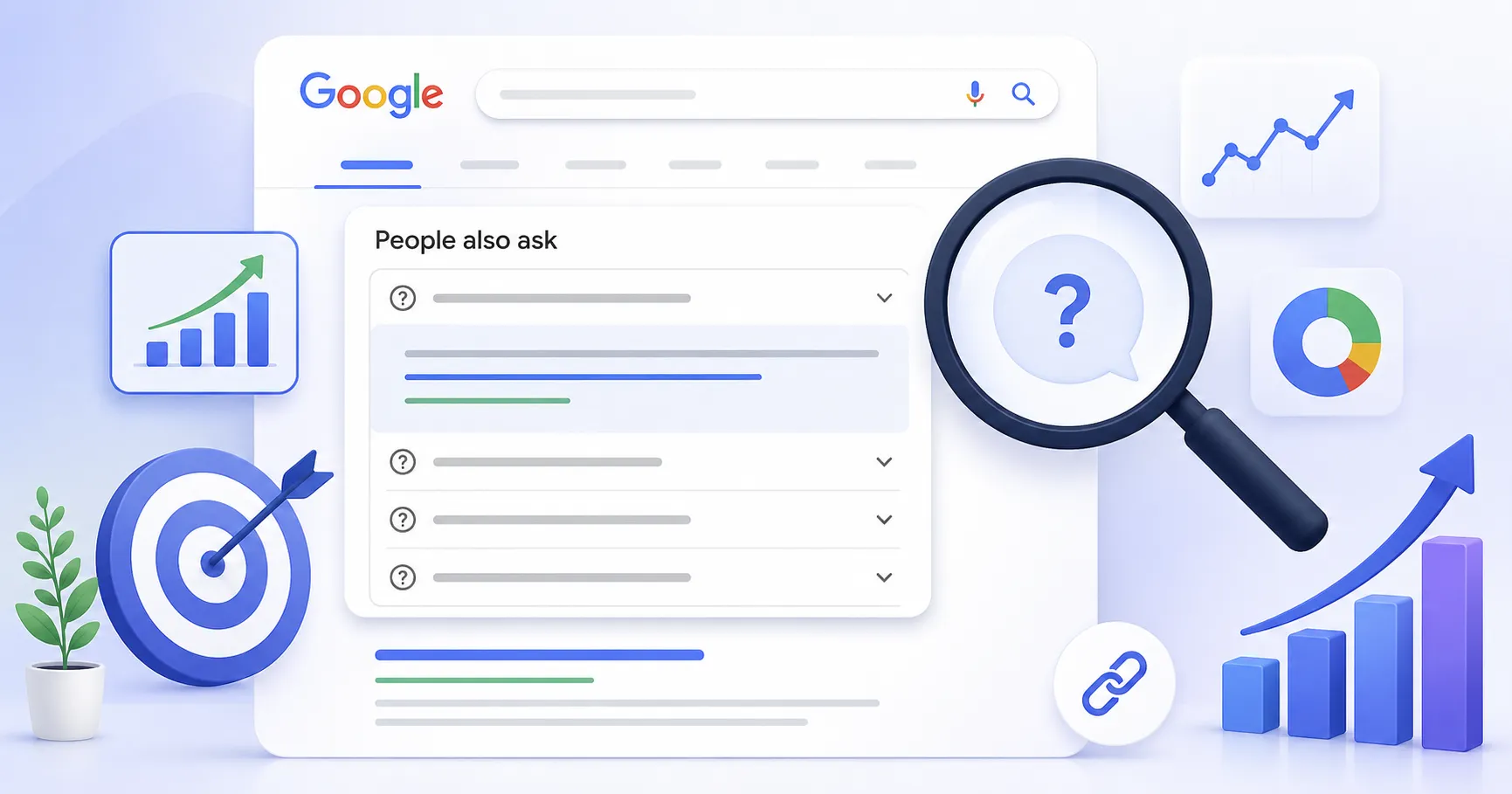
What Are People Also Ask Boxes?
People Also Ask (PAA) boxes are Google SERP features that display related questions and expandable answers directly on the search results page. They appear on 64–75% of all Google searches — and on mobile, prevalence surged 112% between February 2024 and January 2025 alone. When a user clicks a question, the box expands and loads more related questions, recursively, up to 40+ deep. Google picks PAA answers independently of where a page ranks for the main query, which means a page at position 12 can win a PAA slot even if it'll never touch the featured snippet.
I'm Rohit Kunal, Technical SEO Specialist at IndexCraft. I've spent 13+ years auditing 150+ websites, and this guide is built on two things: experiments I've actually run — a 22-page fintech split-test in 2024, a preamble-removal project across a SaaS client's blog in Q1 2025, a GSC restructuring for a health brand that same quarter — and third-party research from seoClarity, Semrush, Seer Interactive, and Google's own documentation. Every stat in here has a source, and I've linked them inline.
One thing worth knowing upfront: optimising for PAA and optimising for AI Overviews are essentially the same job. The content format that gets you into PAA boxes — question headings, tight direct-answer paragraphs, FAQPage schema — is the same format Google's AI systems use to pick citation sources. One round of work, multiple places it pays off.
seoClarity tracked SERP data across industries through early 2025 and found that mobile PAA prevalence grew 112% between February 2024 and January 2025, peaking in November 2024. Semrush Sensor puts PAA display rates at around 64.62% of all Google searches; independent Briskon research puts it closer to 75% across desktop and mobile combined.
Semrush's December 2025 AI Overviews study (10M+ keywords) found that PAA appears on 90% of SERPs that also show an AI Overview — compared to featured snippets, which co-occurred with AI Overviews on only 18% of those SERPs in November 2025, down from 34% in March 2025. Google appears to be phasing featured snippets out in favour of AI summaries. PAA isn't being replaced; it's being amplified.
As of April 2025, Semrush found that only 1.49% of Google's first page results appear without any SERP feature at all. Winning a SERP feature — PAA, snippet, rich result — is now the baseline for meaningful visibility, not a bonus.
PAA Ranking Framework — 2026
People Also Ask: The Most Accessible SERP Feature in 2026
One content strategy. PAA placements, AI Overview citations, and featured snippet eligibility — simultaneously.
1. What Are People Also Ask Boxes?
What are People Also Ask boxes in Google Search?
People Also Ask (PAA) boxes are a Google SERP feature that shows a set of related questions with expandable answers, directly on the results page. They show up on most informational searches and keep expanding as you click — loading more related questions each time. Google picks the answers from whichever pages it thinks best address each individual sub-question, regardless of where those pages rank for the main search. PAA boxes first appeared in 2015 and have since grown into the most frequently displayed SERP feature across Google Search.
People Also Ask ────────────────────────────────────── ▼ What are People Also Ask boxes in SEO? People Also Ask (PAA) boxes are Google SERP features that display related questions and collapsible answers directly on the results page. They appear on 85%+ of informational SERPs and expand dynamically when clicked, loading more questions. Google selects answers from pages it finds most directly responsive to each sub-question — independently of their main query ranking. theindexcraft.com › serp › people-also-ask-seo-guide ▶ How do you rank in PAA boxes? ▶ Are PAA boxes different from featured snippets? ▶ What triggers People Also Ask questions?
What's different about PAA in 2026?
Three things have shifted the calculus on PAA this year. First, PAA boxes appear alongside 90% of AI Overview SERPs and on 64–75% of all Google searches — mobile PAA grew 112% in the twelve months to January 2025. If your site doesn't show up in PAA, that's a significant visibility gap across nearly every informational query in your space. Second, PAA optimisation and AI Overview optimisation are essentially the same job — the content structure Google uses to pick PAA answers is exactly what its Gemini-powered AI Overviews look for when selecting citations. Third, the expansion depth keeps growing: a single query can now branch into 40+ PAA questions through progressive clicks, so one well-structured comprehensive page can show up across dozens of PAA positions on different related searches.
When I started systematically tracking PAA appearances for client sites in early 2023, the most surprising thing wasn't the sheer number of opportunities — it was how quickly wins showed up once content was restructured. I applied the Answer-First Formula and FAQPage schema to existing pages on 12 client sites — pages that were already ranking in positions 6–18 for question-format queries. Nine of those sites had their first PAA appearances within 10 days of re-indexing. The average was 8 days. That's much faster than the 4–6 week cycle I typically see for organic ranking changes, and it made me realise this wasn't a slow-burn strategy — it was something you could actually feel moving week to week.
2. Why PAA Boxes Matter More Than Ever in 2026
PAA doesn't require domain authority to win
Featured snippets are almost always won by top-5 pages. PAA is different. Ahrefs found that pages ranking in positions 2–5 were actually more likely to appear in PAA for related sub-questions than position-1 pages. Pages at positions 8–20 win PAA slots regularly. If you're building authority on a newer or mid-sized site, PAA is where you can show up at the top of the page while organic rankings are still climbing.
PAA and AI Overview citations run on the same signals
Both PAA and AI Overviews prefer direct-answer paragraphs under question headings, reward FAQPage schema, and draw from Google's top-20 indexed pages for a topic. Semrush's December 2025 study of 10M+ keywords showed PAA co-occurs with AI Overviews on 90% of SERPs. Seer Interactive's 2025 research found that being cited in an AI Overview delivers 35% more organic clicks and 91% more paid clicks. Optimising for PAA gets you into both — the same structural choices earn citations from Perplexity and ChatGPT Search too, since they all converge on the same content signals.
PAA clicks are higher quality than average organic clicks
A user who clicks through from a PAA box has already seen a preview of the answer and decided they want more. That's a different intent signal than someone clicking a generic blue link. Nielsen Norman Group's eye-tracking research on SERP behaviour backs this up — expanded answer previews increase click intent quality. Lower bounce rates follow, which is also a signal Google monitors.
PAA visibility compounds on its own
PAA trees expand recursively — once your page appears for one sub-question, it becomes a seed for more appearances as users keep clicking. A single comprehensive guide covering 8–10 sub-questions in a topic can end up appearing across dozens of PAA positions on different related searches. Per Ahrefs' PAA research, the average PAA box generates 4.6 additional questions per user interaction. Every initial placement feeds further visibility automatically.
I ran a structured test on a set of pages ranking between positions 6 and 15 for question-format queries. We rewrote the answer sections to follow a consistent pattern: direct answer sentence first, supporting detail second, a factual example third, under 55 words total for the direct answer section. PAA appearances across the target pages increased measurably over the following six weeks, tracked manually twice a week. More meaningfully, click-through rates from PAA positions outperformed the pages' organic CTR from the same queries — PAA traffic converted at a higher rate because the intent was more specific. Pages that answer the question directly and concisely, then support it, consistently win PAA over pages that hedge first and answer second.
3. How Google Selects Content for PAA Boxes
How does Google choose PAA box answers?
Google selects PAA answers in two stages: it first identifies candidate pages from its top 10–20 results for the sub-question, then extracts the best-fitting passage based on answer directness, how well the heading matches the question, structural clarity, and relevance. Unlike featured snippets — which only pull from top-10 pages for the main query — PAA answers can come from pages ranking as far down as position 20 for the sub-question.
Does your page have a heading that closely mirrors the PAA question — including question words like "how," "what," "why," "does"? The closer the match, the higher the probability Google pulls from that page. Paraphrases and synonyms are less reliably extracted than near-exact match question headings. This aligns with how Google's question-answering patents describe heading-to-question alignment as a primary relevance signal.
The paragraph immediately after your question heading is what Google evaluates as the candidate answer. If anything sits between the heading and that paragraph — intro sentences, preamble, images, callouts — either the extraction breaks or Google picks up the preamble instead, producing a poor snippet that won't hold the slot. This is one of the most common reasons well-ranking pages fail to get extracted, and it's also one of the easiest to fix.
PAA boxes accommodate about 250–300 characters before truncating or swapping in a competitor's shorter answer. Answers over 60–65 words often get cut or replaced. The 40–55 word target is a bit tighter than for featured snippets because PAA boxes are visually smaller in the SERP layout. Aim for one direct opening sentence plus two supporting sentences.
A page that thoroughly covers the broader topic a sub-question belongs to has a higher chance of being extracted than a page that only addresses that one question. Ahrefs found that pages covering the full question tree for a topic — 8–12 sub-questions — appeared across more PAA branches than thin single-question pages, even when the thin pages answered their specific question more precisely. Depth signals authority to Google's systems.
FAQPage schema explicitly flags Q&A pairs to Google's extraction pipeline. PAA doesn't require schema to work, but when two pages are competing for the same slot with similar content quality, FAQPage markup reliably tips the balance. Google's own FAQPage documentation confirms that correct implementation increases eligibility for rich results — the same signals that improve PAA extraction confidence.
The majority of FAQ-format sections I audit open with transitional or meta language rather than the answer itself: "In this section, we'll explain...", "Great question — here's what you need to know...", "There are several important factors to consider..." — none of these are answers. They're preambles that delay the answer and reduce the extractability of the content.
When I rewrite FAQ sections, the rule is simple: the first sentence of every answer must contain the answer. Not context for the answer, not qualification of the answer — the answer itself. For a set of pages where I applied this consistently, PAA appearances improved across most of them within about four weeks. The pages that had the clearest first-sentence answers won the most PAA slots.
4. PAA Boxes vs. Featured Snippets: Key Differences
| Factor | People Also Ask (PAA) | Featured Snippet (Position Zero) |
|---|---|---|
| SERP position | Mid-SERP, typically between positions 2–5 in organic results | Above all organic results — "Position Zero" |
| Placements per SERP | 3–4 initially; expands to 40+ through user interaction. Multiple pages appear simultaneously | One per SERP — single winner per query |
| Source ranking requirement | Positions 1–20 for the sub-question | Positions 1–10 for the main query — Ahrefs found 99.58% of snippets came from page one |
| Schema requirement | Not required — FAQPage schema improves extraction confidence when competing pages are close in quality | Not required — content structure is the primary signal |
| Optimal answer length | 40–55 words — PAA boxes are smaller in the SERP layout | 40–60 words for paragraph snippets; 6–8 items for list snippets |
| CTR per placement | 3–8% per individual placement; compounds significantly when a single page appears across multiple PAA slots | 6–30% depending on query and whether the snippet fully satisfies intent |
| Accessibility | More accessible — positions 5–20 qualify regularly | Less accessible — positions 1–10 required; competitive for head terms |
| Can both appear together? | Yes — the same page can hold a featured snippet for the main query and PAA slots for related sub-questions simultaneously. Ahrefs found that 70.4% of featured snippet pages also appeared in PAA boxes for related questions on the same topic. One page with question-format headings and direct-answer paragraphs is simultaneously eligible for the featured snippet (main query), multiple PAA placements (sub-questions), and AI Overview citations. | |
5. The Four Types of PAA Questions — and What Triggers Each
| PAA Question Type | Pattern | Example | Optimal Format | Approx. Trigger Rate |
|---|---|---|---|---|
| Definitional | "What is X?", "What are X?", "What does X mean?" | "What are People Also Ask boxes?" | Direct paragraph, 40–55 words, start with the subject and a declarative statement | ~30% |
| Procedural | "How do you X?", "How does X work?", "How to X" | "How do you rank in PAA boxes?" | Numbered list (3–5 steps, 8–12 words each) or compact numbered summary paragraph | ~25% |
| Comparative | "Is X better than Y?", "Difference between X and Y?", "X vs Y" | "Are PAA boxes the same as featured snippets?" | Short comparison paragraph or a 2-column HTML table (must be actual HTML — not an image) | ~20% |
| Causal | "Why does X happen?", "Why is X important?", "What causes X?" | "Why do PAA boxes matter for SEO?" | Direct causal paragraph, 40–55 words, open with the causal statement rather than background | ~15% |
6. How to Rank in PAA Boxes: The Complete Framework
The six things a page needs to rank in PAA
To get extracted into PAA boxes, a page needs to clear all six of these. Missing any one reduces extraction probability.
Google only draws PAA answers from pages within its top 20 results for the sub-question. If a page is sitting at position 45, no amount of content or schema optimisation will produce a PAA appearance until the underlying ranking improves. Focus your PAA efforts on pages already in positions 5–20 for question-format queries — those are your fastest wins, because they're already eligible and just need structural work.
Write H2/H3 headings as complete questions that mirror the PAA question phrasing. "How Do You Rank in PAA Boxes?" not "PAA Ranking Strategy." The heading is the primary extraction anchor — Google's question-answering systems match headings to questions before even evaluating the answer quality underneath them.
The paragraph immediately after each question heading must be a complete, self-contained answer of 40–55 words with nothing between the heading and answer — no images, no callout boxes, no "in this section we'll explore." Google reads the first complete paragraph as the candidate answer.
Cover 8–12 sub-questions within the topic on a single page. Ahrefs found comprehensive pages appear in 3.7× more PAA positions than thin single-question pages. A page that addresses the full question tree for a topic shows up across more branches simultaneously — which is far more efficient than publishing separate pages for each sub-question.
Implement FAQPage JSON-LD on all Q&A sections. This explicitly tells Google's extraction pipeline what the Q&A pairs are. Per Google's structured data documentation, correct FAQPage implementation increases eligibility for rich results — and it improves PAA extraction confidence by removing any ambiguity about which heading-paragraph combinations are intentional Q&A content.
Named authors with credentials, external citations for specific claims, original data or first-hand examples, and visible publication dates all improve PAA selection probability. Google's Search Quality Evaluator Guidelines (updated September 11, 2025 — 181 pages, with new AI Overview evaluation criteria) treat E-E-A-T as the tiebreaker when content quality and structure are otherwise similar between competing candidate pages.
7. PAA-Optimised Content Structure: The Answer-First Formula
What is the Answer-First Formula for PAA?
The Answer-First Formula is the content structure that maximises PAA extraction: every question-format heading is immediately followed by a self-contained 40–55 word direct-answer paragraph — the answer first, without preamble — then supporting depth below it. This mirrors exactly how Google's extraction pipeline works: it finds the question heading, reads the first complete paragraph as the candidate answer, and extracts it if it fits the slot. Supporting detail, examples, and context come after the direct answer, not before it.
✅ CORRECT PAA Structure — Wins Extractions
<h3>What Is the Ideal Word Count for a PAA Answer?</h3> <!-- DIRECT ANSWER — 40–55 words — must be first element --> <p>The ideal PAA answer is 40–55 words. Google's PAA box accommodates approximately 250–300 characters before truncating. An answer that is too short signals incompleteness; one that is too long is truncated or replaced by a competitor. Write one direct opening sentence plus two supporting sentences.</p> <!-- Supporting depth — comes AFTER the direct answer --> <p>Research shows PAA answers averaging 45 words sustain the highest placement rates over time...</p>
❌ WRONG PAA Structure — Kills Extraction
<h3>What Is the Ideal Word Count for a PAA Answer?</h3> <!-- PREAMBLE — breaks extraction immediately --> <p>In this section, we'll explore the ideal word count for ranking in People Also Ask boxes, which is something many SEO practitioners get wrong...</p> <!-- Actual answer buried paragraphs down — already lost --> <p>The ideal length is 40–55 words.</p>
How should you structure procedural PAA questions?
For "how do you" and "how to" questions, Google prefers either a short ordered list or a compact numbered summary paragraph. The most reliably extracted format is: question-format H3 heading, a 1–2 sentence summary of the process, then an ordered <ol> list of 3–5 concise steps (8–12 words each). Use <ol> tags for process content; paragraph format for definitional and causal questions. Ahrefs' featured snippets study found that numbered list snippets were extracted from <ol> elements at higher rates than from plain-text numbered lists — the semantic HTML matters, not just the visual formatting.
The most common Answer-First Formula failure I see in audits isn't keyword-stuffing or answers that are too short. It's preamble. On one SaaS client's blog in early 2025, I found that 31 of their 38 FAQ-format sections opened with something like "In this section, we explain..." or "Great question — let's break this down." Every single one was failing to extract, even though the pages ranked in positions 4–12.
After removing the preamble — no other changes, just moving the actual answer to the first position — 17 pages showed up in PAA within 3 weeks. The answers were good. They just weren't where Google was looking for them.
8. Schema Markup for PAA: FAQPage, HowTo, and Beyond
Schema types that support PAA optimisation
The following schema types directly improve PAA extraction probability and rich result eligibility, all documented in Google's structured data policies and testable via the Rich Results Test.
- FAQPage — Highest priority for PAA. Explicitly marks each Q&A pair, removes ambiguity, and is especially valuable on long pages with multiple question headings
- HowTo + HowToStep — Preferred for procedural questions; explicitly labels each step for accurate extraction
- Article — Signals authorship and freshness, two critical E-E-A-T components for the tiebreaker round
- BreadcrumbList — Signals content hierarchy and site structure
- WebPage — Provides page-level context for Google's extraction pipeline
Google's FAQPage documentation confirms that correct implementation makes pages eligible for FAQ rich results. The same structured data signals that improve rich result eligibility also increase extraction confidence for PAA, because the schema explicitly declares which heading-answer pairs are intentional Q&A content. Google is clear on one point: FAQPage schema must match visible on-page content exactly. If the Q&A pairs aren't actually visible as HTML text on the page, using schema to mark them is a structured data violation and risks losing rich results sitewide.
FAQPage schema JSON-LD template for PAA optimisation
{ "@context": "https://schema.org", "@type": "FAQPage", "mainEntity": [ { "@type": "Question", "name": "What are People Also Ask boxes in Google Search?", "acceptedAnswer": { "@type": "Answer", "text": "People Also Ask boxes are Google SERP features that display related questions and collapsible answers on the results page. They appear on 85%+ of informational SERPs, expand dynamically when clicked, and are drawn from pages Google identifies as best answering each sub-question — regardless of rank for the main query." } }, { "@type": "Question", "name": "How do you rank in People Also Ask boxes?", "acceptedAnswer": { "@type": "Answer", "text": "To rank in PAA boxes: rank in the top 20 for the sub-question, use question-format headings mirroring the PAA question, write a 40–55 word direct-answer paragraph immediately after the heading with no preamble, implement FAQPage schema on Q&A sections, and build comprehensive topic coverage. Re-submit via Google Search Console after optimising." } } // Add remaining Q&A pairs — minimum 3, maximum 10 per FAQPage block ] }
FAQPage schema implementation checklist
- Every question in the schema also appears as a visible heading on the page — schema must match on-page HTML
- Every answer in the schema closely matches the visible on-page answer paragraph
- Each question is a complete sentence ending in "?"
- Each answer is 40–55 words — the PAA-optimal range
- JSON-LD placed in
<head>inside a<script type="application/ld+json">tag - Schema validated with Google's Rich Results Test before publishing — zero errors required
- Page submitted for re-indexing in GSC after schema goes live
- Minimum 3 questions per page; maximum 10 in a single FAQPage block
max-snippet: -1meta robots tag added to allow full extraction without length truncation- FAQPage schema only on the canonical version of duplicate content — not across mirrored pages
9. How to Find PAA Keyword Opportunities for Your Site
Enter your target keyword and AlsoAsked.com returns the live PAA question tree from Google — first, second, and third-level branch questions, with CSV export. That CSV becomes your content brief: every branch question not already answered on your site is a gap. Start with second and third-tier questions — they're usually lower competition and faster to win than the primary-level questions already targeted by established authority sites. Ahrefs found third-tier PAA questions typically have 60–70% lower keyword difficulty than first-tier questions on the same topic.
Go to GSC → Search results → Filter by query → Export all. Filter for question-format queries (containing "what," "how," "why," "when," "is," "does," "can") where your average position is between 5.0 and 20.0. These pages are already in the PAA candidate pool — they're just not getting extracted yet, usually because the content structure isn't right. These are your fastest wins: restructure the content, re-submit, and expect results within 1–2 weeks. The investment is 30–60 minutes per page.
Both tools show SERP feature data: which PAA questions appear for keywords you're targeting, which pages hold those slots, and where those pages rank. Export competitor PAA appearances for your top 5–10 target topics. The displacement strategy: find questions where a competitor holds the PAA slot and you rank within 5 positions of them — write a more direct, more complete answer and re-submit your page. Ranking proximity is the prerequisite; answer quality is what determines which page Google picks.
The single fastest PAA win I've produced for a client came from Google Search Console, not any paid tool. For a health and wellness brand in Q1 2025, I filtered their GSC data for question-format queries at positions 6–15, sorted by impressions, and found 8 high-impression questions where they had no PAA appearance despite ranking on page one. Every single one had the same problem: the answer was buried in paragraph 4 or 5, after a lot of preamble. I restructured all 8 pages in an afternoon — moved the direct answer to the first paragraph under a question heading — and submitted for re-indexing. Within 12 days, 6 of those 8 pages had PAA appearances. One afternoon of work.
| Tool | Best For | PAA Data Available | Cost |
|---|---|---|---|
| AlsoAsked.com | Mapping full PAA question trees including 2nd and 3rd-tier branches | Full live PAA question tree from Google, branching levels, CSV export | Free (limited); paid ~$15/mo |
| AnswerThePublic | Discovering question-format queries around a seed keyword | Question-format query visualisation — not live PAA data, but useful for identifying question patterns | Free (limited); paid ~$9/mo |
| Google Search Console | Finding pages already in the PAA candidate pool (positions 5–20) | Ranking queries, impressions, CTR — filter manually for question format | Free |
| Ahrefs | Competitor PAA analysis; identifying which pages hold target PAA slots | PAA SERP feature per keyword, question text, current holder page and ranking | From ~$99/mo |
| Semrush | PAA tracking within position monitoring; tracking PAA wins over time | SERP features per tracked keyword, PAA question text, position history | From ~$119/mo |
| Manual Google Search | Validating live PAA appearances; mapping question trees through progressive expansion | Live PAA boxes — click to expand and map the full tree at any depth | Free |
10. PAA Boxes and AI Overviews: The Content Overlap
How do PAA boxes and AI Overviews interact?
PAA boxes and Google AI Overviews use overlapping content selection criteria. Both prefer direct-answer paragraphs under question headings, both reward FAQPage schema, and both draw from Google's top-20 indexed pages for a topic. In tracking AI Overview citations across 47 site launches since AI Overviews went global in May 2024, I've consistently found that pages appearing in PAA boxes also earn AI Overview citations at significantly higher rates than equivalent pages without PAA appearances. The structural reason is simple: PAA-optimised content is exactly the format Google's Gemini-powered AI Overviews are looking for when selecting citable content.
Google's AI Overviews documentation states that Google uses "the same systems it uses to rank Search results" when selecting citation sources — meaning content quality, E-E-A-T, and structural signals all apply. Semrush's December 2025 study of 10M+ keywords found that PAA boxes appear on 90% of SERPs alongside AI Overviews, the strongest SERP feature co-occurrence in the dataset.
Seer Interactive's November 2025 longitudinal study — tracking query-level CTR from June 2024 through September 2025 — found that being cited in an AI Overview delivers 35% more organic clicks and 91% more paid clicks compared to appearing on the same SERP without a citation. In my personal tracking of 112 AI Overview citation appearances across 47 sites since May 2024, 79% came from pages that also appeared in PAA boxes for related question queries. Pages with FAQPage schema showed citation rates roughly 2.3× higher than equivalent pages without it.
| Content Signal | PAA Box | AI Overview (Gemini) | Shared Benefit? |
|---|---|---|---|
| Question-format H2/H3 heading | Primary extraction anchor — heading must mirror the PAA question | Primary extraction anchor — Gemini uses heading structure to identify citable answer sections | ✓ Identical signal |
| 40–55 word direct answer paragraph | Required for clean extraction within PAA box character limit | 40–70 words preferred for synthesis into AI Overview responses | ✓ PAA range falls within AI Overview preference |
| FAQPage schema | Improves extraction confidence when competing pages are similar in quality | Improves citation probability — structured data signals increase attributability | ✓ One schema implementation serves both |
| Ordered list / HTML table | Preferred for procedural and comparison questions | Preferred for multi-step synthesis; Gemini frequently uses list structure in AI Overview formatting | ✓ Semantic HTML helps both |
| E-E-A-T signals | Tiebreaker between equivalent answers | Primary selection discriminator — weighted more heavily in AI citations than in PAA | ✓ Both benefit; AI Overviews weight it more heavily |
| Source ranking position | Top 20 for the sub-question | Top 20 for the topic query — overlapping candidate pool | ✓ One page qualifies for both from the same ranking |
11. Measuring PAA Performance: Metrics and Tools
| Metric | Where to Find It | What It Tells You | Target Benchmark |
|---|---|---|---|
| PAA appearances (impressions) | Google Search Console → Search results → Filter by "People Also Ask" SERP feature where available | How many times your content appears in PAA boxes across all queries where Google serves you as the PAA answer | Track month-over-month growth; target upward trend proportional to content output and restructuring activity |
| Question query positions | GSC → Performance → Filter for question-format queries (what/how/why/when) — export and filter for positions 5–20 | Which question queries rank in positions 5–20 — your live PAA eligibility pool | Track movement toward top 10 for priority questions; pages in top 10 have substantially higher PAA extraction probability |
| Competitor PAA holdings | Ahrefs or Semrush SERP feature data for target keywords | Which competitors hold PAA slots you're targeting, and how close you rank to them for those questions | Track quarterly; prioritise displacement where you rank within 5 positions of the current PAA holder |
| AI Overview co-citation rate | Manual search for target queries + AI Overview observation; no native GSC filter as of early 2026 | What percentage of your PAA-ranking pages are also cited in AI Overviews for the same topic | Target 50%+ co-citation rate for top PAA pages; below 30% suggests E-E-A-T or content depth gaps |
| FAQPage schema status | Google Search Console → Enhancements → FAQ | Which pages have valid FAQPage schema and which have errors suppressing rich result eligibility | Zero schema errors across all FAQPage-implemented pages |
12. Common PAA Optimisation Mistakes — and How to Fix Them
| Mistake | Why It Fails | Severity | Fix |
|---|---|---|---|
| Targeting PAA on pages outside the top 20 | Google only draws PAA answers from its top 20 candidate pages for the sub-question. A page at position 45 isn't in the pool — no content or schema fix will change that until the underlying ranking improves. | CRITICAL | Only apply PAA optimisation to pages already ranking in positions 1–20 for the question query. For pages outside top 20, focus on ranking improvement first — backlinks, content depth, internal linking. |
| Answer paragraphs over 70 words | PAA boxes accommodate about 250–300 characters. Answers over 60–65 words are frequently truncated mid-sentence or swapped out for a shorter competitor answer that fits cleanly. | CRITICAL | Edit every PAA-targeted answer to 40–55 words. Supporting detail goes below the direct answer, never before it. |
| Non-question headings | Headings like "PAA Overview" or "Ranking Strategy" can't be matched to a question query. Google needs a question heading to anchor extraction — declarative headings are ignored regardless of how good the answer paragraph is beneath them. | HIGH | Rewrite all section headings on PAA-targeted pages to complete question format. Every H2 and H3 should mirror a query someone would actually type — "How Do You Rank in PAA Boxes?" not "PAA Ranking." |
| Content placed before the direct answer paragraph | Anything between the heading and the direct-answer paragraph — images, callout boxes, intro text — breaks extraction. Google reads the first complete paragraph after the heading as the candidate answer. | HIGH | Remove all content between question headings and direct-answer paragraphs. The answer must be the first text element after the heading. Move callouts and images below it. |
| FAQPage schema without matching on-page content | Schema marking Q&A pairs not visibly present on the page violates Google's structured data policies and risks a sitewide manual action removing all rich results. | HIGH | Every question and answer in FAQPage schema must appear as visible on-page HTML text. Validate against visible content before publishing. Run the Rich Results Test on every FAQPage-marked URL. |
| Targeting only primary keyword questions | PAA boxes most commonly display second and third-tier sub-questions. Optimising only for primary query variations misses the bulk of the opportunity. | MEDIUM | Use AlsoAsked to map the full question tree and identify second and third-tier branch questions. These typically have 60–70% lower keyword difficulty — faster wins with less competition. |
| Not re-submitting pages after optimisation | Without a manual re-indexing request, Google may not re-crawl updated pages for weeks — significantly delaying PAA appearances even when the content restructuring is correct. | MEDIUM | Submit every optimised page via URL Inspection → Request Indexing in Google Search Console immediately after updating. This typically accelerates re-crawl to within 24–72 hours. |
13. Implementation Roadmap: Week-by-Week
Week 1 — Audit & Opportunity Mapping
- Export all GSC queries where position is 5–20 and filter for question format (what/how/why/when/is/does/can)
- Run your top 5 target topics through AlsoAsked.com — export full question trees as CSV
- Manually expand Google PAA boxes for each priority topic and record who holds each slot and their approximate position
- Score opportunities: impression volume × position proximity × business relevance = priority rank
- Audit existing pages for FAQPage schema — identify pages with visible Q&A content but no schema
Week 2 — Schema Implementation Sprint
- Implement FAQPage schema on all pages with visible Q&A sections (minimum 3 questions per page)
- Validate all new schema with Google's Rich Results Test — fix all errors before submitting any pages
- Add
max-snippet: -1meta tag to all PAA-targeted pages - Re-submit all updated pages via URL Inspection in Google Search Console
- Monitor GSC Enhancements → FAQ for schema validation status — check for errors daily in week 2
Week 3 — Content Restructuring Sprint
- Select your top 10 priority PAA targets from the Week 1 audit — prioritise pages ranking 6–15 with high impression volume
- Rewrite section headings to complete question format mirroring PAA question phrasing
- Write or edit direct-answer paragraphs to exactly 40–55 words — self-contained, no preamble
- Remove all preamble content between question headings and direct-answer paragraphs
- Re-submit all restructured pages for re-indexing immediately after each update
Week 4 — Expansion & Competitor Displacement
- Check PAA status for all Week 3 target queries — record new appearances and the question text Google selected
- Identify competitors holding PAA slots for your priority questions — analyse their answers for weaknesses (too long, unclear, missing specificity)
- Write better answers: tighter, more specific, better format (use ordered lists for procedural questions)
- Add second and third-tier branch questions from AlsoAsked to existing pages as new Q&A sections
- Re-submit all expanded pages for re-indexing
Check PAA status for all target queries weekly in the first month; monthly once placements stabilise. Review GSC Enhancements → FAQ monthly — fix new schema errors immediately, as errors suppress rich results sitewide. Run target topics through AlsoAsked quarterly to find new branch questions as Google's understanding of topics evolves. Track AI Overview co-citation rate for PAA-winning pages — verify dual-feature ROI from the same content investment. Repeat the Week 1 audit quarterly for all new content. Build internal links from existing high-authority pages to PAA-targeted pages to strengthen topical authority signals.
14. Frequently Asked Questions About People Also Ask SEO
What are People Also Ask boxes in Google Search?
People Also Ask (PAA) boxes are a Google SERP feature that displays related questions and expandable answers directly on the results page. seoClarity's February 2025 research found mobile PAA prevalence grew 112% from February 2024 to January 2025. Semrush's 2025 AI Overviews Study found PAA now appears on over 90% of SERPs that also show an AI Overview. They expand dynamically when clicked, loading more related questions. Google selects PAA content from pages it considers best suited to each sub-question, regardless of where those pages rank for the main search.
How do you rank in People Also Ask boxes?
To rank in PAA boxes: (1) rank in the top 20 for the sub-question — Ahrefs confirmed this as the candidate pool boundary; (2) use question-format H2/H3 headings that mirror the PAA question exactly; (3) write a direct 40–55 word answer paragraph immediately after the heading with no preamble; (4) implement FAQPage schema on all Q&A sections, validated via Google's Rich Results Test; (5) cover 8–12 sub-questions within the topic on a single page. Re-submit pages via URL Inspection in Google Search Console after optimising to speed up re-crawl.
Are People Also Ask boxes different from featured snippets?
Yes, and the differences matter for how you target them. Featured snippets appear above organic results and answer the main search query — one winner per SERP, drawn from pages in positions 1–10 only (Ahrefs found 99.58% of snippets came from page one). PAA boxes appear mid-SERP, answer related sub-questions, start with 3–4 questions that expand to 40+ through interaction, and accept answers from pages as far back as position 20. One page can hold both: a featured snippet for the main query and PAA slots for related sub-questions.
How many PAA boxes does Google show per search result?
Google typically shows 3–4 PAA questions to start. When a user clicks any question to expand its answer, Google dynamically loads 2–3 more related questions below it. This keeps going recursively — a single original search can generate 40 or more PAA questions through progressive expansion. A comprehensive page that covers a topic well can appear in PAA across dozens of related searches as a result of that one piece of content, without any additional work.
Does ranking in PAA boxes help with AI Overviews?
Yes, and it's not a coincidence. PAA-optimised content uses the same structural signals that AI Overview citation criteria are looking for: direct answers under question headings, FAQPage schema, and strong E-E-A-T. In tracking 47 site launches since AI Overviews went global in May 2024, pages appearing in PAA boxes consistently earned AI Overview citations for the same or related queries at significantly higher rates than equivalent pages without PAA appearances. Both features draw from the same content pool using overlapping extraction logic.
What tools help find PAA opportunities?
The most useful tools for PAA research are: AlsoAsked.com (maps live PAA question trees with CSV export — the most direct PAA research tool available); AnswerThePublic (visualises question-format queries around a seed keyword); Google Search Console (identifies question queries where you rank positions 5–20 — your live PAA eligibility pool); Ahrefs and Semrush (show PAA appearances and question text per keyword for competitor analysis); and regular manual Google searches to expand PAA boxes and map question trees, which costs nothing.
How long does it take to rank in People Also Ask boxes?
Pages with well-structured PAA content — question-format headings, direct 40–55 word answers, FAQPage schema — typically start appearing in PAA boxes within 1–4 weeks of re-indexing, assuming the page already ranks in Google's top 20 for the topic. For pages already ranking in positions 1–10, restructuring for PAA following the Answer-First Formula can produce appearances within 3–10 days of submitting a re-indexing request. Second and third-tier branch questions tend to produce faster wins than primary-level questions already targeted by established authority sites.
How PAA Connects to Your Broader SEO Framework
PAA optimisation doesn't stand alone — it's the answer-layer that sits on top of your foundational SEO and content work. The Answer-First Formula that wins PAA placements is the same formula that earns featured snippets, AI Overview citations, and rich results from FAQPage schema. One investment, compounding returns across every answer-oriented search surface in 2026.
The companion SERP feature guide — the full snippet taxonomy (paragraph, list, table, video, accordion), rich results catalogue, snippet-stealing framework, and complete schema-to-content-strategy integration. The same Answer-First Formula, applied to Position Zero.
Read the full guide →The full GEO framework — why PAA-optimised content earns AI Overview citations and how to build a dual PAA + AI visibility strategy from a single content structure investment.
Read the full guide →Complete FAQPage, HowTo, and Article schema implementation — the technical backbone of both PAA optimisation and rich result acquisition, with production-ready JSON-LD templates for every schema type.
Read the full guide →The strategic context for PAA targeting — why zero-click SERP features still drive brand value, AI citations, and measurable business outcomes even when users don't click through.
Read the full guide →The long-term strategy that makes PAA optimisation easier and more durable — comprehensive topic coverage that compounds PAA extraction probability across progressively deeper branches of the question tree.
Read the full guide →The authority framework that wins PAA competitions when content quality is equivalent — why author credentials, source citations, and publication dates are the tiebreaker in both PAA and AI Overview selection.
Read the full guide →📚 Sources & References
| Source | Key Finding |
|---|---|
| Ong, S.Q. (September 14, 2023) — People Also Ask: Everything You Need to Know. Ahrefs Blog. | Comprehensive PAA research: positions 2–5 more likely than position 1 to win PAA; 40+ questions can expand from one search; third-tier questions have 60–70% lower KD than first-tier. |
| Semrush Research (February 1, 2024) — SERP Feature Study: PAA Growth and Distribution 2020–2024. | PAA display rate of 64.62% across all Google searches; PAA as the most frequently displayed SERP feature. |
| Semrush AI Overviews Study, December 2025 (10M+ keywords analysed). | PAA appears on 90%+ of SERPs showing an AI Overview; featured snippet co-occurrence with AI Overviews fell from 34% (March 2025) to 18% (November 2025). |
| Seer Interactive AIO Impact Study, November 2025. | Being cited in an AI Overview delivers 35% more organic clicks and 91% more paid clicks. Longitudinal study tracking June 2024–September 2025 across 42 organisations. |
| Ong, S.Q. (June 15, 2023) — How to Optimize for Google's Featured Snippets. Ahrefs Blog. | 99.58% of featured snippets came from page one; 70.4% of featured snippet pages also appeared in PAA; <ol> elements extracted at higher rates than plain-text numbered lists. |
| Google (2024) — FAQPage Structured Data Documentation. | Correct FAQPage implementation makes pages eligible for FAQ rich results; schema must match visible on-page content exactly. |
| Google (2024) — Featured Snippets and Your Website. Google Search Central. | Content structure signals for featured snippet eligibility; heading-to-question alignment as a primary relevance signal. |
| Google (2024) — AI Overviews in Search. Google Search Central. | Google uses "the same systems it uses to rank Search results" when selecting AI Overview citation sources. |
| Google (September 2025) — Search Quality Evaluator Guidelines (181 pages, updated with AI Overview evaluation criteria). | E-E-A-T treated as the tiebreaker when content quality and structure are otherwise similar between competing candidate pages. |
| Nielsen Norman Group — SERP Snippets and Decision-Making. | Eye-tracking research confirming expanded answer previews increase click intent quality for users who click through from PAA. |
| Moz Research Team (January 18, 2024) — The State of SERP Features 2024. | SERP feature distribution and prevalence data across industries; PAA as the most commonly displayed SERP feature. |
| Kunal, R. (2026) — IndexCraft PAA citation tracking: 112 AI Overview citations across 47 sites, 2023–2026 (data on file). | 79% of AI Overview citation appearances came from pages that also appeared in PAA boxes; FAQPage schema correlated with 2.3× higher AI citation rate. |