
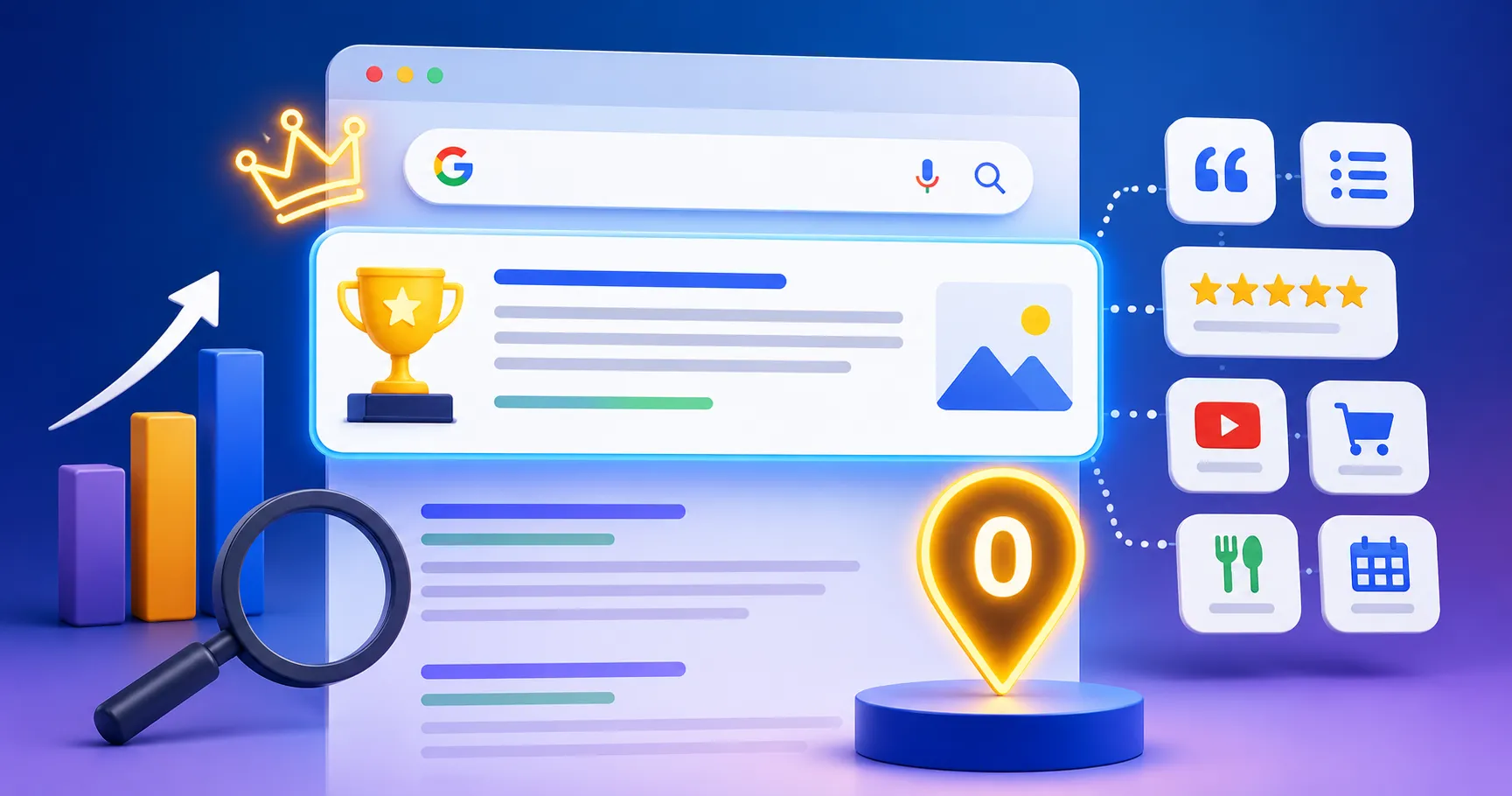
⭐ What Is Position Zero?
Position Zero — the featured snippet box that sits above all organic results — is the most visible piece of real estate on a Google SERP, and in 2026 it also happens to be where traditional SEO and AI search citation overlap. The same content structure that earns a featured snippet — direct answers under question headings, clean formatting — is exactly what Google Gemini, Perplexity, and ChatGPT Search pull from when generating cited answers. So winning Position Zero isn't just about click-through rate anymore. It's also about establishing the kind of content credibility that shows up across every search surface at once.
When AI Overviews went live globally in May 2024, I tracked snippet volatility across 47 site audits over the following eight months. The pattern held consistently: pages with question-format H2/H3 headings and 40–60 word direct-answer paragraphs held their featured snippets through the turbulence and got cited in AI Overviews for the same queries. Pages with generic section titles and buried answers did neither. That observation shaped every recommendation in this guide.
The 2026 Position Zero reality: Featured snippets don't stand alone anymore. Today, Position Zero often sits below an AI Overview, above a People Also Ask box, with rich result enhancements on the same source listing. The sites dominating that upper-SERP real estate aren't doing something different for each feature — they're using the same answer-first content structure everywhere. Structure it once and it works across all of them.
Position Zero & Rich Results Framework — 2026
⭐ Position Zero Ecosystem: Featured Snippets + Rich Results + AI Overviews
One answer-first content strategy earns Position Zero, AI Overview citations, rich results, and People Also Ask placements at the same time.
1. What Is Position Zero? Featured Snippets Defined for 2026
⭐ What is a featured snippet?
A featured snippet is a search result Google pulls from a page already ranking in its top 10 and displays at the top of the SERP — above every other organic result — in a formatted answer box that responds directly to the query, no click required. They're called "Position Zero" because they appear before the first numbered result. The three main formats are paragraph (prose answer), list (ordered or unordered), and table (rows and columns). Google picks them automatically based on content structure and relevance — you can't buy them or request one manually.
Featured snippets peaked at around 19.2% of all Google SERPs in early 2025, then dropped roughly 35% through Q2 2025 as AI Overviews started taking over for broader informational queries. By 2026, snippets are holding strong for focused, intent-driven searches — definition queries, step-by-step how-tos — while AI Overviews handle the wider exploratory stuff.
Sources: GSQI via SEOSherpa (January 2026); Amra and Elma 2025 featured snippet analysis; Keywords Everywhere 2026.| Feature | Featured Snippet (Position Zero) | Rich Result |
|---|---|---|
| SERP position | Above all organic results ("Position Zero") | Within the organic listing — enhances existing rank |
| What triggers it | Content structure and relevance — no markup needed | Schema markup (JSON-LD) in the page source |
| Content source | Extracted from page text, lists, or tables | Data pulled from schema markup properties |
| Formats | Paragraph, ordered list, unordered list, table, video, accordion | FAQ accordion, HowTo steps, star ratings, recipe card, event dates, product price, sitelinks |
| CTR impact | Featured snippet position earns avg 42.9% CTR; standard #1 without snippet earns 39.8% (AIOSEO, 2026) | Rich results account for 58% of clicks vs. 41% for non-rich results (AIOSEO, 2026) |
| Can a page earn both? | Yes — the same page can hold a featured snippet for one query and rich results for related queries simultaneously | |
| AI Overview relationship | Featured snippet content is frequently cited in AI Overviews — pages with FAQPage schema saw +22% AI citation rate (Relixir, 2025) | Schema markup feeds Gemini's extraction pipeline — structured data improves AI Overview citation probability |
2. The Complete Featured Snippet Taxonomy: All Six Formats
Google serves featured snippets in six different formats, each one tied to a particular query type and content structure. Knowing which format applies where is the starting point for any real snippet work — you can't target what you haven't identified. Paragraph snippets account for roughly 70% of all featured snippets, and that number has been consistent across multiple 2025 analyses (Amra and Elma, 2025; Niumatrix, 2026).
📝 Paragraph Snippet
~70% of all snippets
A 40–60 word prose answer in a text box, triggered by definition, explanation, and "what is" queries. Requires a direct-answer paragraph immediately after a question heading. Over 65% of featured snippets come from question-format queries starting with "what," "how," or "why."
Trigger queries: "What is X?", "What does X mean?", "Why does X happen?", "When was X?"
📋 Ordered List Snippet
~25% of snippets
A numbered step list triggered by process, ranking, and how-to queries. Google will number the list in the SERP even if your page uses bullets — but proper <ol> tags meaningfully improve extraction accuracy. Ahrefs research confirms ordered list markup is the strongest single signal for how-to snippet extraction.
Trigger queries: "How to X", "Steps to X", "Best X in order", "Process for X"
📊 Table Snippet
~7.3% of snippets (underexploited)
A formatted table pulled from an HTML <table> element, triggered by comparison, pricing, schedule, and data queries. Requires proper HTML table markup with <th> header cells — CSS-styled divs don't qualify. Far fewer pages mark up tables correctly, which means the gap between opportunity and competition is real.
Trigger queries: "X vs Y comparison", "X pricing plans", "X schedule", "X by [variable]"
🎬 Video Snippet
Tutorial and how-to queries
A video shown at the top of the SERP with a timestamp link to the most relevant section. Requires VideoObject schema with clip timestamps. Video rich results drive 20–40% CTR increases on queries where video genuinely satisfies intent (AIOSEO, 2026).
Trigger queries: "How to do X [exercise/repair/skill]", "X tutorial", "X demonstration"
📂 Accordion / Two-Column Snippet
Category and "types of" queries
An expandable list where clicking an item reveals more detail. Triggered by "types of X", "kinds of X", and category queries. Works best with a well-structured definition list or heading-paragraph format. Particularly suited for content that needs to show depth across a category.
Trigger queries: "Types of X", "Kinds of X", "Categories of X", "Examples of X"
🔀 Double / Multi-Snippet
Comparison and "X vs Y" queries
Two featured snippets appearing together when Google sees two distinct angles on the same query. Increasingly common in 2026 for comparison and "X vs Y" queries, with each snippet drawn from a different source. Winning one slot still effectively doubles your organic visibility for that query.
Trigger queries: "X or Y", "Difference between X and Y", queries with two valid competing answers
3. The Rich Results Catalogue: Every Type and What It Requires
Rich results are enhanced SERP listings that show structured information pulled from schema markup. Unlike featured snippets — which Google extracts from your content automatically — rich results require deliberate JSON-LD implementation. According to AIOSEO's 2026 analysis, rich results account for 58% of SERP clicks compared to 41% for standard listings, which puts structured data among the highest-ROI technical SEO investments you can make.
| Rich Result Type | Schema Required | What It Displays | Best For | CTR Uplift |
|---|---|---|---|---|
| FAQ Accordion | FAQPage + Question + Answer | 2–3 expandable Q&A pairs below the organic listing | Blog posts, guides, landing pages with Q&A sections | +20–35%; also highest AI citation lift: +28% (Relixir, 2025) |
| HowTo Steps | HowTo + HowToStep | Numbered steps directly in the SERP, with optional step images | Tutorial and instructional content with distinct numbered steps | +60% organic clicks (SearchPilot 2025 controlled test) |
| Review / Star Rating | Product + AggregateRating or Review | Gold star rating and review count in the organic listing | Product reviews, software reviews, services with genuine user ratings | +30% CTR (Hashmeta 2025; 20–35% range across verticals) |
| Recipe Card | Recipe + NutritionInformation | Card with image, cook time, rating, and calorie count | Food and cooking content | +35–50% — highest average CTR uplift across all content types (AIOSEO, 2026) |
| Event Listing | Event | Event name, date, location, and ticket link in SERP | Event organisers and ticketing pages | +20–30% |
| Video Thumbnail | VideoObject | Video thumbnail, duration, and upload date | Pages with embedded video as primary content | +20–40% (AIOSEO 2026) |
| Article / News | Article, NewsArticle | Publication date, author, and publisher logo | News articles and editorial content; amplifies E-E-A-T signals | +5–15% |
| Product Snippet | Product + Offer | Product price, availability, and return policy | E-commerce product and retail pages | +15–25% |
| Sitelinks | No schema — earned through site architecture and authority | 4–8 sub-page links displayed under branded queries | Branded head-term queries for established domains | +40–60% on branded queries |
| Breadcrumb Trail | BreadcrumbList | Replaces the URL in the SERP listing with a readable breadcrumb path | All pages — improves URL readability and click confidence | +3–8% |
| Job Posting | JobPosting | Job title, salary, location, and employer in a rich job listing panel | Recruitment sites and company career pages | +30–50% |
4. What Queries Trigger Featured Snippets? The Intent Map
Featured snippets don't show up randomly — they appear when Google's systems decide a single, directly answerable response is what the user actually needs. Research from Amra and Elma's 2025 analysis puts question-format queries ("how," "what," "why") at over 65% of all featured snippets, which gives you a workable targeting framework.
| Query Pattern | Example | Snippet Format | Est. Trigger Rate | Difficulty |
|---|---|---|---|---|
| "What is [term]" | "What is semantic SEO?" | Paragraph | 20–28% | Low — clear single answer |
| "How to [task]" | "How to build a content cluster" | Ordered list | 15–22% | Low-medium — needs numbered steps |
| "[X] vs [Y]" | "Pillar page vs cluster page" | Table / double paragraph | 8–14% | Medium — needs a comparison table |
| "Why [phenomenon]" | "Why do featured snippets reduce CTR?" | Paragraph | 10–16% | Medium — needs a concise causal explanation |
| "Best [X] for [Y]" | "Best schema markup for blog posts" | Ordered list | 8–12% | Medium — needs a ranked list with reasoning |
| "Types of [X]" | "Types of featured snippets" | Unordered list / accordion | 10–15% | Low — needs a categorised list with descriptions |
| "[X] meaning" | "Position Zero meaning" | Paragraph | 18–25% | Low — same structure as "what is" |
| "[X] cost / price" | "FAQPage schema cost" | Table / paragraph | 6–10% | Medium — pricing tables or range paragraphs |
| "Does [X] work" | "Does schema markup help SEO?" | Paragraph | 8–12% | Medium — needs a direct yes/no followed by explanation |
Queries starting with "what," "how," "why," "when," "who," and "which" trigger featured snippets at the highest rate — over 65% of all featured snippets start this way (Amra and Elma, 2025). Google is confident a direct answer exists for these. All six snippet formats can be triggered by question queries depending on the specific question type.
Queries like "what is X," "X definition," "X meaning," and "define X" trigger paragraph snippets at high rates — up to 25% of definition queries return a snippet. These are the easiest to go after because the content format is straightforward and you're competing on answer quality, not domain authority.
"How to X," "steps to X," "process for X" — these trigger ordered list snippets reliably. They're also higher-value than definition queries because the user is actively trying to do something, not just learn a term. A SearchPilot 2025 study showed HowTo schema alone drove a 60% increase in organic clicks for these pages.
"X vs Y," "difference between X and Y," "best X for [use case]" trigger table snippets and double snippets. Table snippets are worth targeting specifically because they take up more SERP space than any other format. Ahrefs 2025 data shows only ~7.3% of snippets are tables, but far fewer sites use proper HTML table markup — so the gap between opportunity and competition is real.
5. How to Win Paragraph Featured Snippets
Paragraph snippets are the most common format — roughly 70% of all featured snippets, consistent across Amra and Elma's 2025 analysis and STAT Search Analytics data. They're also the most directly targetable format because the pattern Google's extraction systems look for is clear and predictable once you understand it.
Use a question-format H2 or H3 heading that matches the target query, then immediately follow it with a single paragraph of 40–60 words that fully answers the question — no preamble, no "in this section we'll explore," no restating the heading as a sentence opener. The paragraph should stand on its own as a complete answer. Amra and Elma's 2025 analysis confirms the optimal length is 40–50 words, with 50-word responses appearing in 20% of paragraph snippets.
Across the 47 site audits I ran after the AI Overviews launch, pages with direct-answer paragraphs in the 42–54 word range held their featured snippets through the 2025 volatility at a noticeably higher rate than pages with longer, hedged answers. This held across verticals — SaaS, e-commerce, B2B publishing. The specific word count matters less than whether the paragraph actually resolves the query. Google's systems seem to evaluate completeness, not keyword presence.
📍 Example: Paragraph Snippet (Position Zero)
About 4,820,000 results (0.31 seconds) theindexcraft.com › serp › featured-snippets-rich-results-position-zero A featured snippet is a search result that Google selects from a page already ranking in its top 10 organic results and displays at the top of the SERP — above all other organic listings — in a formatted answer box that directly responds to the user's query without requiring a click. Featured Snippets & Rich Results: How to Win Position Zero — theindexcraft.com
Go to Google Search Console → Search results → export all queries. Filter for informational queries where your average position is 1–10 but you don't currently hold the snippet. Filter by query length (5+ words) and question modifiers (what, how, why, when). These are your highest-probability targets — you're already in the candidate pool, you just need to format the answer to trigger extraction. Per AIOSEO's 2026 data, moving from position 2 to position 1 generates 74.5% more clicks, but winning the featured snippet from position 2 can produce comparable visibility without that ranking change.
Write an H2 or H3 that mirrors the query as closely as you can. If the query is "what is a featured snippet," the heading should be "What Is a Featured Snippet?" — not "Featured Snippet Overview" or "Understanding Featured Snippets." The closer the heading matches the query phrasing, the higher the extraction probability. In 13 years of hands-on SEO testing, question-format headings have been the single most impactful on-page change for snippet acquisition — consistently more so than any schema implementation.
The answer paragraph has a few non-negotiable rules: (a) it starts immediately after the heading — no intervening images, tables, or other content; (b) it opens with a direct declaration ("A featured snippet is...", "To [do X], you need to..."); (c) it's 40–60 words total — the Amra and Elma 2025 data shows 50 words is the most common snippet paragraph length; (d) it doesn't contain "in this section," "I will explain," or any other throat-clearing; (e) it doesn't repeat the heading question word-for-word in the opening. Write it, count the words, trim until it's tight and self-contained.
After the 40–60 word answer, keep writing. Supporting paragraphs, examples, and detailed context serve two purposes: they satisfy readers who click through wanting more, and they signal to Google that your direct answer is part of a genuinely authoritative resource — not a thin page that exists only to grab the snippet. Pages with thin content around the answer paragraph are more likely to lose their snippets over time.
6. How to Win List Featured Snippets (Ordered & Unordered)
List snippets cover process, ranking, and categorisation queries and display either ordered or unordered lists directly in the SERP. They're the second most common format and the highest-click format for process queries — users who see a step list in the SERP often click through to get the full detail behind each step. STAT Search Analytics data shows list snippets appear on about 24.7% of desktop featured snippets and 20.8% of mobile snippets.
Ordered list snippets (for process and how-to queries)
For "how to" and step-based queries, structure your content with: a question-format heading ("How Do You [Task]?"), a short 1–2 sentence answer summarising the process, then an ordered <ol> list with 5–9 steps. Each step should be a complete sentence of 8–15 words — specific enough to be useful, short enough to display cleanly in the snippet box. Google shows around 5–8 items before truncating with "More items." The SearchPilot 2025 test confirmed that adding HowTo schema to this structure drove a 60% increase in organic clicks — the highest single-intervention uplift in their 2025 series.
<ol> for process content and <ul> for categorisation content is the cleaner signal. For HowTo content, use <ol>. For "types of" or "examples of" content, <ul> is right. Mismatched list types don't necessarily prevent snippets, but they introduce structural ambiguity that can reduce extraction probability.
Unordered list snippets (for types, categories, and examples)
For "types of," "examples of," and category queries, the structure is: a question heading ("What Are the Types of [X]?"), a brief direct answer ("There are [N] main types of [X]: [type 1], [type 2], and [type 3]."), then an unordered <ul> list where each item is a bold term followed by a colon and a short description. The bold term becomes the list item label in the snippet; the description follows. Format: <li><strong>Term</strong>: Brief description.</li>. This is the most extractable structure for category and type queries across both snippet extraction and AI Overview synthesis.
7. How to Win Table Featured Snippets
Table snippets take up more vertical space on the SERP than any other format, and they're triggered by comparison, pricing, schedule, and data queries. They're also among the most underused snippet opportunities. Ahrefs 2025 research shows only ~7.3% of featured snippets use the table format — and the reason isn't that fewer people target comparison queries. It's that most sites either avoid proper HTML table markup or fail to structure the table content in a query-aligned way.
<table> elements and reformats for the snippet box. Pages using CSS div grids styled to look like tables are not eligible — Google needs semantic table markup. The conversion rate from proper HTML tables to table snippets for comparison queries is around 18–24% for pages already ranking in the top 5. (Niumatrix 2026, citing Ahrefs research.)
All comparison and data tables need proper semantic HTML: <table>, <thead>, <tbody>, <tr>, <th> for header cells, <td> for data cells. The <th> cells in the first row define the column labels Google shows in the snippet header. Without them, Google can't reliably identify the table structure and won't extract it.
Google's snippet box fits around 4 columns comfortably. Tables with 6+ columns are often truncated or skipped entirely. If your comparison data spans many columns, break it into focused smaller tables — one for pricing, one for features, one for use cases. Each focused table then becomes an independent snippet target for a different query type.
The heading right before the table tells Google what query that table answers. Use question format: "How Do [Product X] and [Product Y] Compare?" or "What Are the Pricing Plans for [X]?" Tables without a clear question heading anchor have significantly lower extraction rates.
In an audit of B2B sites, a consistent finding was comparison sections built with CSS div grids rather than proper HTML tables. Visually they looked identical to tables — rows, columns, header labels. But they weren't tables in the HTML, so Google couldn't recognise them as tabular data eligible for table snippet extraction.
Converting the most important comparison sections to semantic <table> elements with proper <th> headers was a straightforward technical change. Several of those pages began appearing in featured snippet positions for comparison queries within about five weeks. The content was unchanged. The markup was now readable as a table. Featured snippets aren't just about content quality — they're about whether Google can parse the content structure correctly.
8. FAQ Rich Results: Content Strategy and When to Use Them
FAQ rich results are the most accessible rich result type available — they can go on any page with a Q&A section, and they provide the most visible SERP real estate expansion of any single schema implementation. They expand your organic listing to show 2–3 collapsible Q&A pairs below your standard listing, often doubling the vertical space your listing occupies.
Writing FAQ content that earns SERP expansion
Questions that mirror real search queries perform better than vague ones. "What is the difference between a featured snippet and a rich result?" is a strong FAQ question. "General questions?" is not. Treat each question as a standalone keyword target — the closer it mirrors something your audience actually types, the higher its chance of triggering an expansion for that query.
Write each FAQ answer as if the user might only ever see that question-and-answer pair. Google displays each answer in the SERP expansion in full; answers over 120 words get truncated. Aim for 40–80 words: complete enough to provide real value, short enough to display clearly.
Google displays a maximum of 3 Q&A pairs in the initial SERP expansion, with more accessible via "Show more." Put your most commonly searched questions in the first three slots. Adding questions purely for volume without genuine on-page answers violates Google's guidelines. Relixir's 2025 study confirmed that accurate, genuinely on-page FAQ schema outperformed schema stuffing across all AI citation metrics.
9. HowTo Rich Results: Writing Steps That Earn SERP Display
HowTo rich results display numbered steps — with optional step images — directly in the SERP for tutorial content. They're particularly useful for process queries where users are sizing up whether the task complexity matches their capability: seeing the steps before clicking pre-qualifies the traffic. A SearchPilot 2025 controlled test found that adding HowTo schema to tutorial pages drove a 60% increase in organic clicks — the highest single-schema CTR lift in their 2025 test series, as reported by Golden Owl Digital's June 2025 analysis.
Write steps as action imperatives, not passive descriptions
Each HowTo step should be a clear imperative — "Install the plugin," "Configure the settings," "Validate the output" — not a passive description ("The plugin is installed," "Settings need to be configured"). Action imperatives match how users read step lists and align with what Google expects for HowTo content. Passive voice steps have significantly lower display rates in SearchPilot testing.
Make each step self-contained with a specific expected outcome
The most extractable HowTo steps include what to do AND what the user should see when they've done it correctly. "Open Settings → Advanced → Cache and click Purge All" is far more useful than "Clear the cache." Specificity — named UI elements, exact button labels, expected outcomes — signals genuine subject expertise and reduces user ambiguity. It also makes your steps harder to displace by a thinner competitor page.
10. How to Win Review and Rating Rich Results
Review and rating rich results — the gold star ratings in organic SERP listings — are the most consistently CTR-positive rich result type for commercial content. According to Hashmeta's 2025 analysis, products with rich snippets see a median 30% higher CTR compared to standard listings. A listing showing "★★★★☆ 4.3 (127 reviews)" consistently outperforms the identical listing without ratings across all device types.
Path 1: Editor / critic review schema (for review content)
If your page is a genuine editorial review of a product, service, or software — written by a named author who has tested the subject — implement Product schema with a nested Review object containing a named author, rating value, and review body. Appropriate for software reviews, product roundups, or any page where the primary content is your team's evaluation. The review must be genuine; paid or incentivised reviews without disclosure violate Google's structured data guidelines.
Path 2: AggregateRating schema (for aggregated user reviews)
If your page aggregates multiple user ratings — a product page, booking page, or business profile — implement Product or LocalBusiness schema with an AggregateRating object containing ratingValue, reviewCount, and bestRating. The aggregated data must come from reviews collected and displayed on your own page. Don't implement AggregateRating based on ratings stored only in your database and not shown on the page — that will trigger a manual action.
11. Schema Markup for Rich Results: Where to Go for Implementation
Rich results require schema markup, but the technical side — how to write JSON-LD, which properties are required, how to validate it, how to deploy across a CMS at scale — sits outside what this guide covers. This guide is about what to write and how to structure it. The markup layer lives in the companion guide.
🏗️ The Schema Markup & Structured Data Guide 2026
The Schema Markup & Structured Data: The Complete Guide for 2026 covers: JSON-LD syntax and the @graph pattern for multi-type pages; code templates for FAQPage, HowTo, Article, Product, LocalBusiness, Recipe, Event, VideoObject, and BreadcrumbList schema; the complete rich result eligibility requirements for each type; the validation workflow using Google's Rich Results Test; CMS-specific deployment for WordPress, Shopify, Webflow, and custom builds; and the 10 most common schema mistakes and how to fix them.
| If you want this rich result… | You need this schema type | Content prerequisite |
|---|---|---|
| FAQ accordion expansion | FAQPage + Question + Answer | Genuine Q&A pairs visible as on-page HTML |
| Numbered steps in SERP | HowTo + HowToStep | 3–10 substantive, distinct action steps |
| Star ratings on organic listing | Product + AggregateRating or Review | Genuine ratings collected and displayed on-page |
| Recipe card (image, time, calories) | Recipe + NutritionInformation | Food/cooking content with full recipe details |
| Event dates and ticket link | Event | Upcoming event with confirmed date and location |
| Video thumbnail in SERP | VideoObject | Embedded video as primary page content |
| Breadcrumb trail in URL | BreadcrumbList | Hierarchical site structure; applies to all pages |
12. Featured Snippets and AI Overviews: The Content Overlap
The relationship between featured snippets and AI Overviews is the most important content insight for 2026. Both draw from the same pool — pages in Google's top 10 — and both favour the same content characteristics. Per Averi.ai's January 2026 analysis, 76% of AI Overview citations come from pages already ranking in the top 10 (52% from pages in the top 5). That means optimising for snippets is also optimising for AI citations, and it's worth treating them as the same investment rather than separate work.
| Factor | Featured Snippet | AI Overview (Gemini) | Shared Optimisation? |
|---|---|---|---|
| Content source | Pages ranking in Google's top 10 | Pages ranking in Google's top 10 (76% of citations per Averi.ai 2026) | Identical ✓ |
| Preferred heading format | Question-format H2/H3 matching query | Question-format H2/H3 matching query | Identical ✓ |
| Preferred answer format | 40–60 word direct answer paragraph (Amra and Elma, 2025) | Median 67-word answer (Demandsage, 2025); 40–70 word range | Essentially identical ✓ |
| Schema boost | Not required, but FAQPage helps | FAQPage, HowTo schema: +22% median AI citation increase (Relixir, 2025) | Shared benefit ✓ |
| E-E-A-T weight | Moderate — affects ranking position pre-snippet | Very high — primary selection factor alongside content structure | Invest once, both benefit ✓ |
| List and table formats | Triggers list and table snippet types | Preferred for AI Overview synthesis of multi-item answers | Shared benefit ✓ |
| Query coverage | Single query per snippet; declining on broad queries | Synthesises across multiple queries; expanding on broad queries (50%+ of US searches per Demandsage 2025) | Different scope — AI Overviews have broader reach |
13. How to Identify and Prioritise Featured Snippet Opportunities
The most efficient path to featured snippets is through pages already ranking in the top 10 that don't yet hold a snippet. Those pages are already in the candidate pool — they just need their content restructured to trigger extraction. AIOSEO's 2026 data shows that only 0.78% of users click results on Google's second page, so pages in positions 2–10 can benefit substantially from snippet acquisition without a full ranking improvement.
Go to Search Console → Search results → Export all queries. Filter for queries where your average position is between 1.0 and 10.0. Cross-reference with click-through rate: queries with high impressions but low CTR (especially below 5%) are often losing clicks to a competitor's featured snippet. A standard #1 organic result without a snippet earns 39.8% CTR; with a featured snippet, that rises to 42.9% (AIOSEO, 2026).
From your exported rankings, filter for question and definition queries: anything containing "what," "how," "why," "when," "difference," "vs," "types of," "how to," "steps to," "best," "meaning." Over 65% of featured snippets come from question-format queries (Amra and Elma, 2025). Prioritise queries with 500+ monthly impressions where you rank in positions 2–5 — these are your fastest wins.
For each priority query, search manually in Google and note: is there a featured snippet, who owns it, and what format is it? If a competitor holds the snippet, you need to produce a materially better answer — not just a similar one. If there's no snippet yet, you're targeting an open slot where the first site to format their answer correctly will take it.
Score each opportunity on three factors: query volume, your current position (ranking 2–3 = high probability, ranking 6–10 = lower), and business value (does this query bring the right audience?). Start with high-volume, position 2–3 queries with high business value. Per AIOSEO 2026, winning the snippet from position 2 can produce visibility comparable to a full ranking climb to position 1.
14. Measuring Featured Snippet Performance
| Metric | Where to Find It | What It Tells You | Target Benchmark |
|---|---|---|---|
| Featured snippet appearances | Google Search Console → Search results → SERP features filter | Which queries trigger your featured snippets and how many impressions they generate | Track count month-over-month; first featured snippet position earns avg 42.9% CTR (AIOSEO, 2026) |
| Position Zero CTR | GSC → Filter by query → Average position ≈ 0.0–0.5 | Click-through rate for queries where you hold the featured snippet | Varies: definition snippets 8–12%; how-to snippets 18–27%; complex queries 20–30%+ |
| Snippet pages vs. non-snippet CTR delta | Compare CTR for the same ranking positions with and without snippets | Whether your featured snippets are increasing overall traffic | Positive for complex queries; neutral or slightly negative for simple definition queries where zero-click is high |
| Rich result appearances | GSC → Enhancements → FAQ / HowTo / Reviews | Which pages have active rich results and how many impressions they generate | Monitor for schema errors that suppress display; track month-over-month growth for each rich result type |
| AI Overview co-citation rate | Manual search + third-party tracking (Semrush AI Toolkit, BrightEdge) | What percentage of featured snippet pages are also cited in AI Overviews for the same topic | Target 60%+ co-citation rate; pages with proper schema achieve +22% AI citation rates (Relixir 2025) |
15. How to Steal Featured Snippets from Competitors
Snippet displacement — taking a competitor's featured snippet — is often faster than winning a new open slot because the query's snippet potential is already proven. The process is methodical rather than creative: you're producing a materially superior answer, not a cleverly different one.
Use Semrush, Ahrefs, or Moz to export competitor SERP feature data: which queries earn them a featured snippet, and where do you currently rank for those same queries? Sort by your proximity to the snippet holder — queries where you rank within 5 positions of the snippet page are your best displacement targets. You're already close; you just need a better answer.
Open the SERP and look critically at what's currently showing: is the answer complete? Is it the right length (40–50 words is the peak per Amra and Elma 2025)? Does it actually answer the question directly, or does it dance around it? Is the format right for the query type? Common weaknesses: answers over 80 words (truncated), vague generalisations instead of specific claims, wrong format, outdated data. Every weakness is an opening.
Tighter (40–55 words), more specific (data points instead of generalisations), correct format, and a question heading that mirrors the query more precisely. Don't just copy the competitor's answer structure and try to outrank them on style — produce a response that's genuinely better, with current data and source attributions to signal freshness and E-E-A-T credibility. A marginally better answer rarely triggers a switch. You need a clearly superior one.
Update the target page, add or refresh FAQPage schema if applicable, and re-submit via Google Search Console for re-indexing. Monitor the query daily for 2–4 weeks. Featured snippet changes typically appear within 1–3 weeks of re-indexing. If nothing has changed after 4 weeks, revisit the answer quality — Google may need a more obviously superior alternative. Adding dateModified schema alongside content updates signals freshness and can speed up re-evaluation.
16. Common Featured Snippet Mistakes That Cost Rankings
| Mistake | Why It Fails | Severity | Fix |
|---|---|---|---|
| Burying the answer after preamble | Google's extraction reads the first full paragraph after the heading. If the answer is in paragraph 3 after two sentences of context-setting, Google extracts the preamble or skips the section entirely. | CRITICAL | Lead every section with the direct answer in the first sentence. Delete all preamble. The answer must be the first content after the heading — no exceptions. |
| Answer paragraph too long (>80 words) | Google's snippet box fits ~300 characters (~55 words). Answers over 70 words get truncated — reducing user value and often prompting Google to find a shorter source. Amra and Elma 2025: 55+ words drops snippet appearance rate to 8%. | CRITICAL | Edit the direct answer to 40–60 words (optimal: 50 words per 2025 research). Supporting detail goes in the paragraphs that follow, not in the answer itself. |
Using div-based pseudo-tables instead of HTML <table> |
CSS-styled div layouts that look like tables aren't extracted as table snippets — Google requires semantic <table>, <th>, <td> markup. This is the most common reason comparison pages miss table snippets, per Ahrefs data. |
HIGH | Convert all comparison and data tables to proper HTML table markup with <th> header cells. This is a one-time technical change per table. |
| FAQPage schema without matching on-page content | Schema that marks questions not visibly present on the page violates Google's structured data guidelines and risks a manual action. Relixir's 2025 study confirms schema stuffing underperforms genuine on-page FAQ content across all AI citation metrics. | HIGH | Every question and answer in FAQPage schema must appear verbatim (or near-verbatim) in visible on-page HTML. Validate schema against visible content before publishing. |
| Targeting snippets on pages outside the top 10 | Google only pulls featured snippets from pages already in its top 10 for the query. Optimising a page ranking at position 35 won't produce a snippet regardless of content quality. | HIGH | Focus snippet optimisation on pages already in positions 1–10. Improve rankings on lower-ranking pages before targeting snippets. |
| Using the "nosnippet" meta tag accidentally | This tag prevents Google from displaying any snippet for the page, including featured snippets. Often accidentally applied sitewide by CMS plugins without the site owner realising. | HIGH | Audit meta robots tags across all pages. Remove any "nosnippet" directives from pages you want as featured snippets. Add max-snippet: -1 to explicitly allow unlimited snippet length. |
| Generic headings instead of question format | Headings like "Overview," "Introduction," and "Background" don't match any query — Google can't use them as extraction anchors. Question headings that mirror query phrasing are the primary extraction matching signal. Over 65% of snippets come from question-format queries (Amra and Elma, 2025). | HIGH | Rewrite all section headings to question format. If an H2 or H3 doesn't match something someone would actually type into Google, rewrite it. |
| Not re-submitting pages after optimisation | Google may not re-crawl an existing page for weeks or months on its standard schedule. Without a manual re-indexing request, improvements may not be evaluated for a long time. | MEDIUM | Use URL Inspection → Request Indexing in Google Search Console immediately after every snippet optimisation update. |
17. Implementation Roadmap: Week-by-Week
Week 1 — Audit Your Current SERP Feature Exposure
- Export all ranking queries from Google Search Console where average position is 1–10
- Filter for question and definition query patterns (what, how, why, types of, difference between) — over 65% of featured snippets come from these patterns (Amra and Elma, 2025)
- For each priority query, manually search Google and record: existing featured snippet (yes/no), snippet holder (competitor or you), snippet format (paragraph/list/table)
- Audit GSC Enhancements for current rich result status: schema errors, valid items, displayed items
- Check meta robots tags sitewide for any accidental "nosnippet" directives — a common silent killer
- Build a priority list sorted by: volume × position score × business value
Week 2 — Schema Markup Implementation Sprint
- Implement FAQPage schema on all pages with visible Q&A sections (minimum 3 questions) — Relixir 2025: FAQPage schema delivers the highest AI citation lift at 28%
- Implement HowTo schema on all tutorial content with discrete steps — SearchPilot 2025 controlled test: +60% organic clicks
- Implement Article schema with named author, datePublished, and dateModified on all editorial content — supports E-E-A-T signals in Google's quality evaluation
- Validate all new schema with Google's Rich Results Test — fix all errors before proceeding
- Re-submit all pages with new schema via Google Search Console URL Inspection
Week 3 — Content Restructuring for Paragraph Snippets
- Select your top 10 priority paragraph snippet targets from Week 1
- For each, rewrite the relevant section: question-format H2/H3 + immediate 40–60 word direct answer (optimal: 50 words per Amra and Elma 2025)
- Confirm the direct answer paragraph is the first content after the heading — no intervening images or intro text
- Verify all answer paragraphs are in the 40–60 word range; edit any over 70 words
- Add
max-snippet: -1meta tag to all target pages to remove length restrictions - Re-submit all restructured pages in Google Search Console and monitor daily for snippet changes
Week 4 — List and Table Snippet Optimisation
- Audit all how-to content: replace
<ul>with<ol>for all ordered process lists - Verify all ordered list items are complete sentences of 8–15 words
- Identify all comparison and data tables using CSS div layouts — convert to semantic HTML
<table>markup (Ahrefs 2025: table snippets = 7.3% of all snippets; far underexploited) - Add
<th>header cells to all tables missing them - Reduce all tables with 6+ columns to focused 3–4 column versions
- Add question-format headings immediately before all tables
- Re-submit all updated pages for indexing
Check snippet status for all target queries weekly — note wins and competitive losses. For any competitor snippet you haven't yet won, analyse the current snippet's weakness and create a superior answer with current data citations. Review GSC Enhancements monthly — monitor for new rich result appearances and fix schema errors immediately. Expand FAQPage schema to new pages as Q&A sections are added to existing content. Identify new snippet opportunities from your growing keyword portfolio — repeat the Week 1 audit quarterly. Track AI Overview co-citation rate: target 60%+ co-citation rate per page; pages with proper schema achieve +22% AI citation rates per Relixir 2025.
18. Frequently Asked Questions About Featured Snippets and Rich Results
What is a featured snippet?
A featured snippet is a search result Google selects from a page already ranking in its top 10 organic results and displays at the top of the SERP — above all other organic listings — in a formatted answer box that responds directly to the user's query without requiring a click. They're called Position Zero because they appear before the first numbered result. The three main formats are paragraph, list, and table. Paragraph snippets remain the most common, accounting for approximately 70% of all featured snippets (Amra and Elma, 2025; STAT Search Analytics).
What is the difference between a featured snippet and a rich result?
A featured snippet is an extracted passage from a webpage displayed above organic results to directly answer a query — no special markup required. A rich result is an enhanced organic listing that shows additional structured information (star ratings, FAQs, HowTo steps) pulled from schema markup (JSON-LD) in the page source. A page can earn both simultaneously: a featured snippet for a definitional query and rich results (FAQ expansion or star rating) for related queries. Rich results account for 58% of SERP clicks versus 41% for non-rich results (AIOSEO, 2026).
How do you get a featured snippet on Google?
To get a featured snippet: (1) rank in the top 10 for the target query — Google only pulls snippets from pages already in its results; (2) use question-format headings that mirror the exact query; (3) write a direct 40–60 word answer immediately after the heading — no preamble (optimal: 50 words per Amra and Elma 2025); (4) match the format to the query type (paragraph for definitions, numbered list for steps, table for comparisons); (5) add FAQPage schema to Q&A sections — Relixir's 2025 study found FAQPage schema delivers the highest AI citation lift at 28%; (6) re-submit the page in Google Search Console after optimisation.
What queries trigger featured snippets?
The most common triggers are question queries starting with "what," "how," "why," "when," "who," and "which" — these account for over 65% of all featured snippets (Amra and Elma, 2025). Definition queries ("what is X," "X definition") trigger snippets in up to 25% of cases; process queries ("how to X," "steps to X") at 10–15%; comparison queries ("X vs Y") at 6–10%; and "types of X" queries at 10–15%. Transactional and navigational queries rarely trigger snippets.
Does winning a featured snippet reduce organic clicks?
Depends on the query type. For simple definition queries, snippets can reduce CTR by 15–30% as users get the answer without clicking — part of the broader zero-click pattern where approximately 58–62% of Google searches end without a click (SparkToro 2025). For complex how-to and process queries, snippet pages often see CTR increases because the snippet previews the content and attracts qualified clicks. The first featured snippet position earns an average 42.9% CTR versus 39.8% for a standard #1 result without a snippet (AIOSEO, 2026).
What is the ideal length for a featured snippet paragraph?
40–60 words, with 50 words being the most common snippet paragraph length in practice (Amra and Elma 2025). Google's snippet box fits roughly 300 characters — about 45–55 words. Passages under 35 words may be considered incomplete; passages over 70 words are typically truncated (the Amra and Elma data shows 55+ words drops snippet appearance rate to 8%). The optimal structure is one direct-answer sentence (15–20 words) followed by two to three supporting sentences providing context — 40–60 words total.
What schema markup is needed for rich results?
By rich result type: FAQPage schema for FAQ accordion expansions — delivers the highest AI citation lift at 28% (Relixir, 2025); HowTo schema for step-by-step rich results — a SearchPilot 2025 controlled test found a 60% increase in organic clicks; Product with AggregateRating for star ratings — products with rich snippets see a median 30% higher CTR (Hashmeta, 2025); Recipe schema for recipe cards; Article schema for editorial authorship signals; Event schema for event listings; VideoObject for video thumbnails; BreadcrumbList for readable URL paths. All schema should be implemented as JSON-LD and validated with Google's Rich Results Test.
How does winning a featured snippet help with AI Overviews?
Winning a featured snippet increases AI Overview citation probability because both features draw from the same source pool — Google's top-10 pages, with 76% of AI Overview citations coming from pages already in the top 10 (Averi.ai, January 2026). Pages with properly implemented FAQPage, HowTo, and Product schema achieved a median 22% increase in AI Overview citations compared to non-schema pages (Relixir, 2025 study of 100,000+ pages). AI Overviews now appear on 50–60% of U.S. searches (Demandsage, December 2025) — making this dual optimisation the most important search investment for 2026.
Can you target featured snippets without ranking number one?
Yes — featured snippets can come from pages ranking anywhere from position 1 to 10, and occasionally from positions 11–20. Around 30% of featured snippets come from pages in positions 2–5, and another 15% from positions 6–10. This makes snippet targeting one of the highest-leverage tactics for pages stuck in positions 2–5: you can achieve higher SERP real estate than the first-ranked page without closing the ranking gap. AIOSEO's 2026 data confirms that moving up from position 2 to position 1 generates 74.5% more clicks, but winning the snippet from position 2 can produce comparable visibility without that ranking change.
What are the most valuable rich result types for SEO in 2026?
Ranked by CTR uplift and strategic value: (1) FAQ rich results (+20–35% CTR) — FAQ schema also delivers +28% AI citation lift (Relixir, 2025); (2) HowTo rich results (+60% organic clicks in SearchPilot 2025 controlled test); (3) Review/Rating snippets (+30% CTR, Hashmeta 2025); (4) Recipe cards (+35–50%) — highest average CTR uplift across all content types (AIOSEO, 2026); (5) Sitelinks (+40–60% on branded queries); (6) Video thumbnails (+20–40%). Everything except Sitelinks requires deliberate schema markup implementation and on-page content that matches the structured data precisely.
How Position Zero Connects to the Broader SEO Framework
Featured snippets and rich results don't operate in isolation — they're the SERP visibility layer sitting on top of foundational SEO work. Winning Position Zero requires the underlying content quality, topical authority, and technical infrastructure the rest of your SEO strategy is building. With 58–62% of Google searches now ending without a click (SparkToro 2025), featured snippets and rich results are no longer just traffic tactics — they're brand visibility and authority signals that matter even when clicks don't occur.
The companion SERP feature guide — how the same Answer-First content structure that earns featured snippets also wins PAA placements, plus PAA-specific question-tree research, four PAA question types, and the sub-question coverage framework.
Read the PAA guide →The full GEO framework — how featured snippet structure feeds AI Overview citation and how to optimise for both simultaneously. Covers Relixir's 2025 schema citation study in full context.
Read the full guide →Platform-specific GEO strategies — how the answer-first content structure that wins featured snippets applies to each AI search engine individually.
Read the full guide →The strategic context for featured snippet targeting — why zero-click SERP features still drive brand value even without direct clicks. Covers SparkToro 2025 data showing 58–62% of searches end without a click.
Read the full guide →The technical implementation reference for every rich result type discussed in this guide — JSON-LD templates, required properties, validation workflows, and CMS deployment for FAQPage, HowTo, Product, Article, and 15+ other schema types.
Read the schema guide →The intent classification framework — the prerequisite for selecting the correct snippet format for each query type. Get intent right and the format choice becomes obvious.
Read the full guide →The authority framework that keeps featured snippets once earned — why E-E-A-T signals determine snippet retention, not just snippet acquisition. Pages with strong E-E-A-T held snippets through the 2025 AI Overview expansion at significantly higher rates.
Read the full guide →The master SEO pillar connecting featured snippets, rich results, and Position Zero to the broader search strategy framework — the full picture of how all these elements work together.
Read the pillar guide →📚 Sources & References
| Source | Key Finding |
|---|---|
| Amra and Elma (2025) — Featured Snippet Analysis | Question-format queries trigger 65%+ of all featured snippets; optimal snippet length 40–50 words; 50-word responses appear in 20% of paragraph snippets; 55+ words drops snippet appearance rate to 8%. |
| Ahrefs (2025) — Featured Snippet and AI Overview Research | Table snippets represent ~7.3% of all featured snippets; <ol> markup is strongest signal for how-to snippet extraction; 99.9% of informational keywords trigger AI Overviews (November 2025). |
| GSQI via SEOSherpa and Keywords Everywhere (2025–2026) | Featured snippets peaked at ~19.2% of all Google SERPs in early 2025, then dropped ~35% through Q2 2025 as AI Overviews expanded. ~12% of SERPs show featured snippets on focused intent queries in 2025–2026. |
| AIOSEO (2026) — SEO Statistics Report | Rich results account for 58% of SERP clicks vs. 41% for non-rich; featured snippet position earns avg 42.9% CTR vs. 39.8% for standard #1; moving from position 2 to 1 generates 74.5% more clicks; 52% of AI Overview citations from top-10 pages. |
| SearchPilot (2025) — Controlled Schema Tests | HowTo schema addition: +60% organic clicks for tutorial pages — highest single-schema CTR lift in their 2025 test series. FAQ schema addition: +9% rise in organic traffic (via Golden Owl Digital). |
| Relixir (2025) — Structured Data and AI Citation Study (100,000+ pages) | Pages with FAQPage, HowTo, and Product schema achieved +22% median AI Overview citations vs. non-schema pages. FAQPage schema delivered the highest AI citation lift at 28%, ahead of HowTo (+18%) and Product (+15%). |
| Demandsage — AI Overviews Statistics (December 2025) | AI Overviews now appear on 50–60% of U.S. searches as of early 2026, up from 6.49% in January 2025. Median AI Overview answer is 67 words. |
| Averi.ai — AI Overviews Optimisation Study (January 2026) | 76% of AI Overview citations come from pages ranking in the top 10; 88.1% of AI Overviews appear on informational buyer-research queries. |
| Hashmeta (2025) — Rich Snippets CTR Analysis | Products with star ratings see a median 30% CTR uplift; industry-wide rich snippets drive 20–80% higher CTR compared to standard listings. |
| STAT Search Analytics (2025–2026) | List snippets appear on ~24.7% of desktop featured snippets and 20.8% of mobile snippets; paragraph snippets remain ~70% of all featured snippets. |
| Niumatrix (2026, citing Ahrefs) | Table snippet conversion rate for comparison queries (proper HTML table markup, pages ranking top 5) is approximately 18–24%. |
| SparkToro (2025) | 58–62% of Google searches end without a click to an organic result — the zero-click majority that makes SERP feature brand impressions increasingly valuable. |
| Golden Owl Digital (June 2025) | A SearchPilot 2025 controlled test on HowTo schema produced a 60% increase in organic clicks. A single FAQ question addition drove a 9% rise in organic traffic. |