
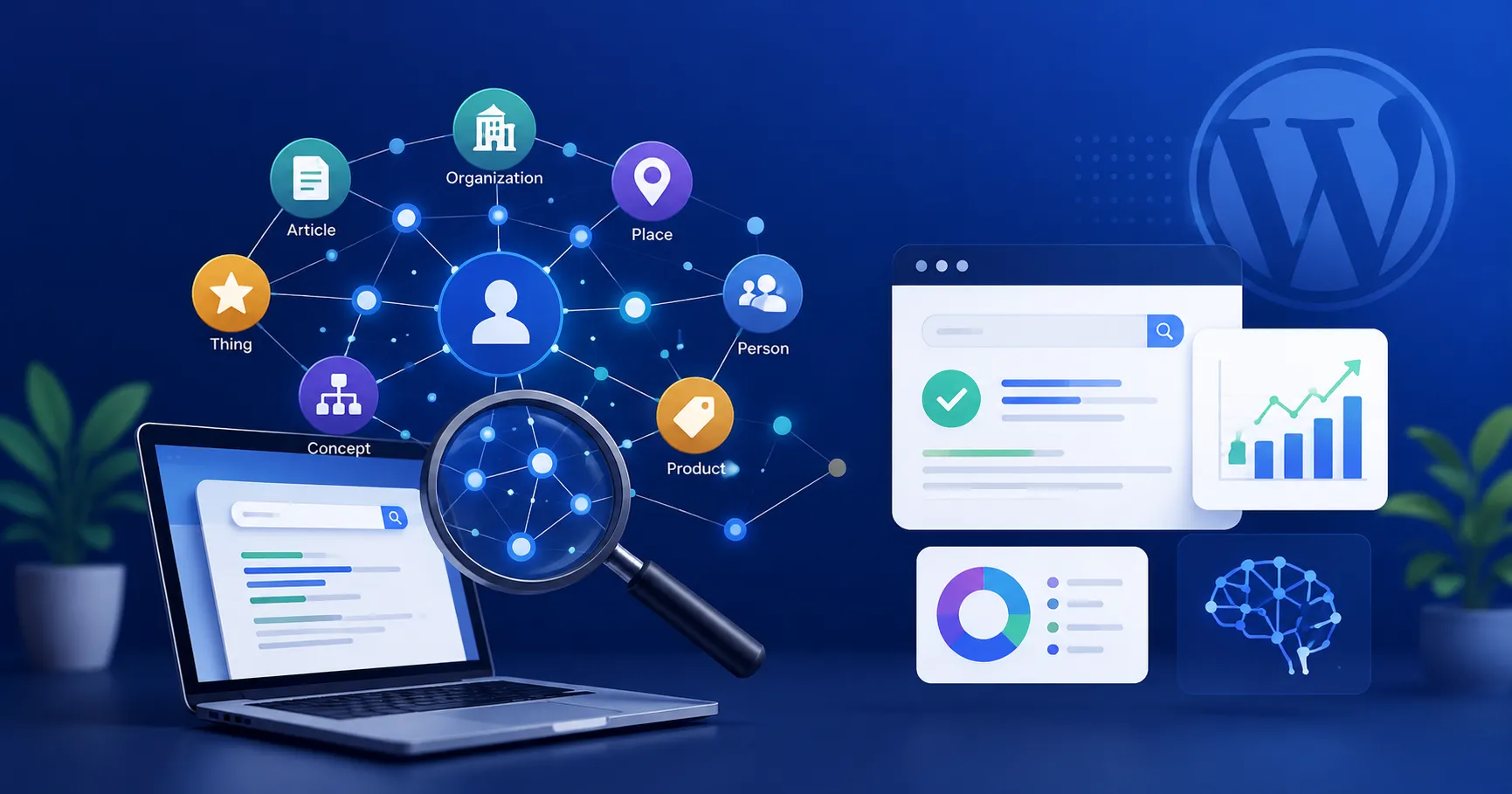
🧠 What is semantic SEO and entity optimisation? (Direct answer)
Semantic SEO optimises content around topics and meaning rather than keywords; entity optimisation makes your brand, people, and products clearly identifiable to Google's Knowledge Graph and to AI systems. Together they help search systems understand your content and trust the source behind it.
Semantic SEO is the practice of optimising content around topics, entities, and meaning, so that Google understands what your page is about, not just which words appear on it. Entity optimisation is the work of making your brand, people, and products clearly identifiable, so search engines and AI assistants can describe you accurately across Google, ChatGPT, Perplexity, and Copilot. One caution up front: Google's AI features doc says AI Overviews and AI Mode need no special markup, so none of this is a shortcut to citations. It is groundwork for being understood and trusted. Semantic depth helps your content get understood; entity clarity helps your brand get trusted as the source.
This guide covers: Knowledge Graph mechanics · NLP and vector embeddings · Schema markup · Wikidata (and what to do without it) · E-E-A-T and YMYL · AEO and GEO across Google, Perplexity, ChatGPT, and Copilot · topical authority · a week-by-week implementation roadmap, drawing on 35+ entity audits of my own (my own data) with every statistic linked to its source.
Who Wrote This, and What I Rechecked
📌 Four Facts Worth Pinning
1. What Is Semantic SEO?
Semantic SEO is the practice of optimising content around topics, entities, and meaning rather than individual keywords. Instead of targeting exact-match phrases, the goal is to cover a subject so completely that readers, and the systems that read pages for them, treat it as a genuine knowledge resource, one that addresses every significant sub-topic, entity, and question chain associated with the subject.
Traditional keyword SEO asks: "Does this page contain the target phrase?" Semantic SEO asks: "Does this page genuinely cover this topic?" Search systems have used language models such as BERT since 2019 to read queries and pages in context, and Google's helpful content guidance asks whether a page gives a substantial, complete answer. Earlier versions of this guide quoted a 30-40% traffic gain from topic clusters. I couldn't trace that to a real study, so it's gone.
2. What Are Entities, and Why Do They Matter More Than Keywords?
Search engines were originally built to match text. That model has been steadily breaking down since 2012, when Google announced its Knowledge Graph under the line "things, not strings."
An entity is any distinct, identifiable thing, a person, a company, a product, a place, a concept, that can be unambiguously told apart from everything else. "Apple" as a text string is ambiguous. But Apple Inc. as an entity has a unique ID in Google's Knowledge Graph: founded in 1976, headquartered in Cupertino, California, makes iPhones and Macs, trades as AAPL. That is not ambiguous. That is an entity.
For SEO, the practical difference is this: when a search engine or an AI assistant describes your brand, it works from what it can find and cross-check about you across sources, not from how often a keyword appears. I can't see inside Google's systems. In my audits (my own data), brands with complete, consistent public information were described accurately far more often than brands with thin or conflicting information.
Organisations
Companies, brands, NGOs: founding date, location, industry, leadership
People
Authors, founders, executives: credentials, affiliations, expertise
Products & Services
Specific offerings: category, specs, manufacturer, reviews
Places
Locations, regions, landmarks: coordinates and entity relationships
Concepts
Abstract topics, disciplines: defined by attributes and related entities
Events
Conferences, launches, historical occurrences, date, participants, outcomes
3. How Google's Knowledge Graph Works
Google's Knowledge Graph is a structured database of entities and the relationships between them, launched in 2012. Search Engine Land's guide reports over 54 billion entities and 1.6 trillion facts as of May 2024, up from 5 billion entities and 500 billion facts in 2020. The guide doesn't name who measured those figures and Google doesn't publish a current count, so read them as a rough sense of scale, not an official number.
Each entity has a machine ID (the Knowledge Graph Search API returns it as an @id like kg:/m/…), a set of attributes, and relationships to other entities. According to the Search Engine Land guide, the graph draws on open sources such as Wikipedia and Wikidata, government and licensed data, structured data on websites, feedback from claimed panels, and, in limited ways, natural language processing. Google's own Knowledge Graph help page says facts come from compiled public sources, licensed data and content owners, and it doesn't name Wikipedia or Wikidata. So the exact mix is partly unknown.
🔍 A simplified model of how entity confidence builds (my illustration, not a documented Google pipeline)
4. Why Entity SEO Matters More Now Than Two Years Ago
Semrush's study of 10M+ keywords found AI Overviews on 24.61% of queries in July 2025 and 15.69% in November 2025, so the share moves a lot. Earlier versions of this guide said cited articles "cover 62% more facts" and that thin entity records were the root cause of low AI Overview visibility. I can't verify the first, and the second is correlation from my own audits at best. Google says AI features need no special markup and rest on the same SEO basics (AI features doc).
I can't tell you how each assistant works internally, and I removed the AI-referral growth figure earlier versions carried because I couldn't trace it to a primary source. What I can say from my own audits (my own data): when ChatGPT, Perplexity or Gemini described a client brand wrongly or generically, the brand's public profiles were usually inconsistent or missing. Asking them about your brand takes ten minutes, and the wrong answers tell you where to start.
Google's helpful content guidance says E-E-A-T is not a specific ranking factor and that trust is the most important part of it. The rater guidelines (latest edition September 11, 2025, per this summary) guide human raters, and their ratings aren't a direct ranking factor. Still, the questions raters ask (who made this, are they credible, can it be checked?) map neatly onto identifiable people and organisations, so clear, consistent author and brand records are sensible work. That mapping is my interpretation, not a Google statement.
Jason Barnard of Kalicube tracked the graph through two updates on June 13 and June 20, 2025. By his count it shrank 6.26%, with over 3 billion entities deleted, and event entities fell 76.91% (Search Engine Land). Those are one tracker's figures and I found no Google statement confirming them. The sensible takeaway is modest: entities backed by consistent outside sources are the safer bet, though the article doesn't show which signals decided who survived.
5. What Entity Types Matter, and What Does Each Need for Knowledge Graph Inclusion?
One of the most common mistakes is implementing a single Organization schema block on the homepage and considering entity SEO done. Different entity types need genuinely different treatment, different schema types, different verification sources, different external corroboration strategies.
| Entity Type | Key Attributes for KG Inclusion | Primary Schema | My Priority | Useful Corroboration Sources |
|---|---|---|---|---|
| Your Brand (Organisation) | Legal name, founding date, industry, headquarters, founders, official website, products/services | Organization | CRITICAL | Wikidata, Wikipedia, Crunchbase, business registries, Google Business Profile |
| Your Authors (Person) | Full name, professional role, expertise domain, employer, credentials, authored works, verified profiles | Person, ProfilePage | CRITICAL | Wikidata, LinkedIn, Google Scholar, industry publications with author bylines |
| Topic Entities in Your Niche | Concept name, related sub-concepts, domain relationships | Article about, DefinedTerm | HIGH | Wikipedia, academic publications, industry body definitions |
| Products | Product name, manufacturer entity, category, specs, review data, GTIN/SKU, pricing | Product, Offer | HIGH (commercial) | Google Merchant Center, review sites, manufacturer structured data, see IndexCraft's e-commerce SEO guide |
| Location Entities | Business name, address, phone, hours, category, geo-coordinates | LocalBusiness, GeoCoordinates | HIGH (local) | Google Business Profile, Yelp, TripAdvisor, Apple Maps, see IndexCraft's local SEO guide |
| Concept Entities | Concept name, domain, relationships to sub/parent concepts | Thing, AboutPage | MEDIUM | Wikipedia, topical authority content clusters |
6. Entity Salience: How Prominently You Feature in Your Own Content
Salience is a concept from Google's Cloud Natural Language API, which scores how central each entity is to a text on a 0 to 1 scale. It's a public tool, not a disclosed ranking signal: Google hasn't said Search uses these scores. It is still a handy proxy for "is this page clearly about X?". A brand mentioned once in a footer would score near zero, while a brand that is the subject of the title, H1 and body would score much higher.
Where this becomes a real problem is on homepages. Many company sites have a brand name only in the navigation logo, no statement in the body copy of who they are, when they were founded, what they do, or who is behind it. A reader, or any NLP tool, struggles to tell who the page is about. That is fixable without a redesign, it mostly requires a rewritten About section and proper schema.
- Is the entity named in the page title and H1?
- Is it the primary subject in the schema?
- Is it mentioned early (first 100 words) and often enough to be obvious?
- Are related entities used accurately in context?
- Are its attributes stated explicitly in the body copy?
- Is the naming consistent across the site?
- Do other entity-focused pages link to it internally?
- Do authoritative outside sources cite it?
7. NLP: Why Clear Writing Helps Machines (and People)
Natural language processing (NLP) is the field of AI that lets software read human language. Google has publicly used models such as BERT in Search since 2019, but it doesn't publish a list of "NLP dimensions" it scores pages on. The table below is my own editing checklist for writing clearly about entities. It is not Google's scoring system.
| Checklist Item | What a Careful Reader Checks | How to Do It |
|---|---|---|
| Entity recognition | Which entities does this page discuss? Are they correctly identified and disambiguated? | Reference entities clearly and unambiguously. Use full names on first mention. Provide contextual clues for disambiguation. |
| Sentiment and stance | What is the page's position on the entities it discusses? | Be clear about your stance. Genuine analysis with a clear view reads better than vague, non-committal content. |
| Topical completeness | Does the page cover the topic's expected sub-topics and related concepts? Are important aspects missing? | Map all sub-entities and related concepts within your topic. Ensure no major sub-topic is left unaddressed. |
| Factual alignment | Do the factual claims on this page match authoritative sources? | Verify all factual claims against authoritative sources. Cite your sources. Don't publish anything you haven't checked. |
| Semantic coherence | Does the content flow logically? Do entities and concepts connect in a coherent narrative? | Structure content with clear logical progression. Use transitional language that signals relationships between concepts. |
| Expertise depth | Does the language use reflect genuine expertise? Does the vocabulary match what an expert would use? | Use accurate technical terminology. Demonstrate nuanced understanding. Address edge cases that only experts would know. |
8. Vector Embeddings: A Simple Way to Picture Semantic Similarity
Vector embeddings are mathematical representations of words, sentences, or whole documents as lists of numbers. Pages covering similar topics end up close together, even when they don't share a single keyword. Search engines, Google included, use techniques like this to relate queries to pages beyond exact words (Google has called one version neural matching). I can't show you Google's actual embeddings, so treat the three steps below as a simplified picture.
In an embedding system, text is converted into a high-dimensional vector, a numerical fingerprint of the text's meaning, topics and entities. Two pages, one about "how to improve website loading speed" and another about "web performance optimization techniques", would get similar vectors despite sharing almost no keywords.
The query is converted the same way, so it captures the user's intent, the entities referenced and the scope of what they want.
Cosine similarity measures how close the query vector sits to each page vector. Real search systems combine closeness with many other signals, so closeness alone doesn't decide rankings or citations. Earlier versions quoted a correlation figure (r=0.84) between embedding alignment and AI Overview selection from a vendor study that doesn't publish its method. I couldn't verify it, so I removed it.
9. What Are the Six Core Technologies Powering Semantic Search?
Knowledge Graph
Google's database of entities and their relationships (Search Engine Land reports 54 billion entities as of May 2024). It powers Knowledge Panels and entity lookups. Google doesn't document it as the "source of truth" for ranking or for AI Overview accuracy checks.
BERT / MUM / Gemini
Language models behind modern search. BERT reads context in both directions. MUM, announced in 2021, is a multimodal model trained across 75 languages. Google has said AI Overviews run on a custom Gemini model, but it doesn't say Gemini runs core ranking.
Entity Recognition (NER)
Named Entity Recognition extracts and classifies entities mentioned in text: people, organisations, locations, products, concepts. Search and AI systems use techniques like this to work out what a text is about at the entity level, not just the keyword level.
Schema.org Structured Data
The standard vocabulary for declaring entities on web pages. Microsoft's Fabrice Canel said at SMX Munich in March 2025 that schema markup helps Microsoft's LLMs understand content (Search Engine Land). Google's AI features doc says no special schema is needed for AI Overviews or AI Mode, although standard structured data still matters for the features Google supports.
Vector Embeddings
Mathematical representations of content meaning in multi-dimensional space. Enables semantic similarity matching between queries and content without keyword dependency. The technology that makes "cardiovascular exercise benefits" match "how running improves heart health."
Topical Authority (a concept, not a Google score)
An SEO concept for how fully a site covers a subject. Google hasn't said it has a topical authority score. It is still a useful planning idea: cover the entities and subtopics that matter in your niche, and link them sensibly.
10. What Does a Complete Entity Optimisation Playbook Look Like?
Entity optimisation has six layers. Work through them in order, each one builds on what came before.
Layer 1: Entity identification
Before writing any content, map every significant entity it should reference. Use Google's Natural Language API, InLinks, MarketMuse, or Frase, or audit the entities that top-ranking competitor pages reference. For an article about "email marketing automation," that map includes: email marketing (topic entity), automation (concept entity), specific platforms (product entities), and the author (person entity).
Layer 2: Unambiguous entity referencing
On first mention, use the entity's full, canonical name: "Google Analytics 4 (GA4)" not just "analytics." "Apple Inc." not just "Apple" when context could suggest the fruit. Give entity-recognition tools enough context to classify the entity correctly. Once the first clear reference is in place, abbreviations are fine.
Layer 3: Structured data declaration
Use Article schema with about and mentions properties linking to entity identifiers (Wikidata URLs, Wikipedia URLs). Declare authors with Person schema and the publisher with Organization schema. Schema.org defines about and mentions, but Google doesn't document using them in Search. Google also says structured data isn't required for AI features, so this layer is about clarity, not a citation hack.
Layer 4: Entity relationship mapping
Don't just list entities, show how they relate. "Mailchimp is an email marketing automation platform that competes with ActiveCampaign and integrates with Shopify, WordPress, and Salesforce." That one sentence establishes entity type, competitive relationships, and integration relationships. Google's Knowledge Graph is built on relationships.
Layer 5: Entity coverage completeness
For any topic, there's a set of entities that expert coverage is expected to include. Audit top-ranking competitor content to find the gaps in yours. Earlier versions quoted a "15+ connected entities = 4.8× boost" figure from a vendor study. I couldn't verify it, so there is no magic count here: aim for complete, accurate coverage.
Layer 6: Cross-content entity consistency
Keep entity references consistent across your entire site. If one page refers to your company as "IndexCraft" and another uses a different abbreviation, systems matching your records may not merge them correctly. A consistent brand name, author name, and key entity attributes across every page strengthens entity recognition site-wide.
One of the more instructive failures I've audited was a software company losing ground to smaller competitors despite having more backlinks and longer publishing history. The issue was entity relationship gaps, their content covered their product category extensively, but it wasn't semantically connected to the adjacent entities that define the space. Their competitors had built content that explicitly named and connected these entities: the methodologies, standards, and tool categories their product related to.
My read: AI answers favoured the competitors when adjacent entities came up in the query, most likely because those entities were explicitly connected in the competitors' content. I can't prove the mechanism. What I can say is that connecting entities explicitly, in plain crawlable text, is cheap to try. — Rohit Kunal
11. What Is the Closed-Loop Approach to Schema Markup?
Schema markup is how you make entity declarations machine-readable. But let me be direct: schema alone is not a complete entity strategy. Without external corroboration: Wikidata, consistent third-party profiles, schema tells Google only what you claim to be. You need independent sources saying the same things before Knowledge Graph confidence accumulates.
The approach that works best in practice is what I call a closed loop: your website's Organization schema declares your brand as an entity and links outward to verified external profiles via the sameAs property. Each of those external profiles links back to your official website. The idea is that every profile agrees with the others, so anyone (or any machine) who starts from one point reaches the same facts. Google's Organization doc says only that sameAs takes URLs of other pages with more information about the organization.
"@type": "Organization",
// Must match exactly: Crunchbase name, LinkedIn Company name, GBP name
"name": "IndexCraft",
"legalName": "[Your registered legal name]",
"url": "https://theindexcraft.com",
"logo": "https://theindexcraft.com/toolslogo.webp",
"foundingDate": "[YYYY]",
"founder": {
  "@type": "Person",
  "name": "Rohit Kunal",
  "url": "https://theindexcraft.com/author-rohit-kunal"
},
// No Wikidata entry yet — the sameAs array still closes the loop
// using every corroborating profile that is available today
"sameAs": [
  "https://www.crunchbase.com/organization/[your-profile]",
  "https://www.linkedin.com/company/[your-page]",
  "https://www.google.com/maps/place/?q=place_id:[YOUR-GBP-PLACE-ID]"
  // Add a Wikidata URL here once independent citable coverage exists —
  // see the alternative-path callout above for how to build toward it
]| Schema Type | Entity Signal | Key Properties | My Priority |
|---|---|---|---|
Organization | Brand entity declaration | name, url, logo, sameAs, foundingDate, founder, address, knowsAbout | CRITICAL |
Person | Author entity declaration | name, jobTitle, worksFor, sameAs (LinkedIn, Scholar), knowsAbout, hasCredential, image | CRITICAL |
Article | Content entity declaration | author (→ Person), about (→ entity URIs), mentions (→ entity URIs), datePublished, publisher (→ Organization) | CRITICAL |
Product | Product entity declaration | name, brand, description, offers (→ Offer), aggregateRating, review, sku, category | HIGH (commercial) |
FAQPage | Q&A content markup | mainEntity → Question/Answer pairs. Google stopped showing FAQ rich results on May 7, 2026 (see its updates log), so this is optional now. It does no harm when the Q&As are visible on the page. | OPTIONAL |
HowTo | Process markup | step, tool, supply, totalTime. HowTo isn't in Google's Search gallery and Google cut back HowTo rich results in 2023, so treat it as optional. | OPTIONAL |
about and mentions properties: useful, but don't oversell them. These Schema.org properties on Article let you say which entities a page covers. Set about to the main topic and mentions to secondary ones, using Wikipedia or Wikidata URLs where one exists. Google doesn't document using them in Search, and I have no controlled test showing they move rankings or citations. I add them because they cost little and make the page's subject unambiguous to any parser.12. Is Wikidata Necessary, and What If You Don't Qualify Yet?
Wikidata is the single most underused tool in entity SEO work, when a brand actually qualifies for an entry. Most practitioners either don't know it's relevant to this workflow, or assume it's reserved for Wikipedia-famous brands. Both framings miss the real issue: Wikidata is not optional-but-easy, it's optional-but-conditional. It requires independent, citable, third-party coverage that many otherwise strong businesses, newer brands, service businesses without press coverage, founder-led companies pre-funding-announcement, simply don't have yet. That's not a dead end. It's a sequencing question.
sameAs property. Google's own Knowledge Graph help page doesn't name Wikidata as a source, although Search Engine Land's guide lists it, so I treat it as likely helpful, not guaranteed.- Google Business Profile: fully completed and verified, even for non-local service businesses; it is Google's own record of the business
- LinkedIn Company Page: complete, with founding date, size, and a description matching your site
- Crunchbase profile: free to create, doesn't require funding history, and widely copied by other sites
- Relevant industry directories: Clutch, GoodFirms, or sector-specific listings, whichever your buyers actually use
- A dedicated, schema-marked About/Company page on your own site, the canonical source the other profiles can point back to
- Digital PR and guest contributions: every citable mention is a brick toward eventual Wikidata notability, so this work is the prerequisite, not a detour
Once you do have citable third-party coverage, press mentions, a registry filing, directory listings, here's how to create the entry correctly:
Search wikidata.org for your brand name first. Auto-generated stub entries sometimes appear when Wikipedia articles exist. If one exists, complete it rather than creating a duplicate, two QIDs claiming to be the same brand sends contradictory signals. Verify the label matches your canonical name exactly, then add missing properties: official website (P856), founding date (P571), industry (P452), and founder (P112).
Create a free Wikidata account, confirm no duplicate exists, then create a new item. Minimum properties: instance of (company or business; look up the exact item), official website (P856), country (P17), inception (P571), industry (P452) and founder (P112), plus identifier properties for profiles you hold. Check each property ID on Wikidata before you use it. For every property, cite an independent published source, a press mention, Companies House filing, industry directory listing. Entries that cite only your own website are the ones that get deleted.
Once your entry is live and assigned a QID, add the Wikidata URL (https://www.wikidata.org/wiki/Q[YOUR-QID]) to the sameAs array in your Organization schema. This closes the loop: anyone who follows the sameAs link finds a record that agrees with your site. Run the page through the Schema Markup Validator after deploying to confirm the sameAs values parse.
I implemented a full entity footprint for a mid-size B2B software company: a Wikidata entry with five independently cited sources, Organization schema with a complete sameAs array, and a rewritten About page clearly stating when the company was founded, what it built, and who for.
Three months in, Perplexity's description of the company shifted from a generic near-miss to a detailed, accurate answer. It's tempting to credit Wikidata, but the About rewrite and schema changes landed at the same time, so I can't separate them. A Google Knowledge Panel appeared in month four, the brand's first despite being seven years old. Branded organic CTR in Search Console was up 22% year over year over the same window, though branded CTR moves for plenty of other reasons. Treat this as one case, not a benchmark. — Rohit Kunal
13. E-E-A-T Through an Entity Lens
E-E-A-T is Google's quality framework for judging content. Its helpful content guidance says E-E-A-T is not a specific ranking factor, and the rater guidelines' scores aren't a direct ranking signal either. Reading the questions it asks, though, I find most of them are about identifiable people and organisations. That reading is mine, not Google's.
| E-E-A-T Dimension | How I Read It | How to Build It as an Entity Signal | My Priority |
|---|---|---|---|
| Experience (E) | Does the author entity have documented, first-hand experience with this topic? Not claimed, actually documented and verifiable. | Author bio pages with real career history. Case studies with real data and outcomes. Dated, specific experience claims that can be traced back. | HIGH |
| Expertise (E) | Is this person or brand entity visibly connected to a recognised domain of knowledge? | Person schema with educational credentials. An author page with a publication history. Content that covers a domain systematically over time. | HIGH |
| Authoritativeness (A) | Do other trusted entities recognise this brand or person as authoritative? Independent citations, not self-declarations, answer this. | Earn coverage in industry publications through digital PR and link building. Produce original data that other credible sources cite. Get listed in authoritative databases relevant to your sector. | HIGH |
| Trustworthiness (T) | Is the entity's information accurate and consistent across every source where it appears? This is the dimension that entity SEO work most directly addresses. | Consistent entity data across all platforms. Accurate, current Wikidata entry. HTTPS. Clear authorship attribution. Regular checks for data drift across external profiles. | CRITICAL |
author property in Article schema pointing to the Person entity URL, not just a name string in the byline. Kalicube Pro's tracking found that a March 2024 Knowledge Graph update raised Person entities with E-E-A-T-friendly descriptors (writers, researchers, academics, journalists) by 38%, while total Person entities rose 17% (Search Engine Land). That is one tracker's count, and Google didn't say the update was about E-E-A-T, so don't read it as proof.13b. YMYL Categories and Negative E-E-A-T Signals
E-E-A-T scrutiny is not uniform across the web. Google's Quality Raters' Guidelines apply a materially higher threshold to YMYL content — Your Money or Your Life: any topic where inaccurate, low-quality, or misleading information could directly harm a reader's health, finances, safety, or major life decisions. The table below is my practical checklist, not a list of Google requirements.
| YMYL Category | Examples | What I Recommend |
|---|---|---|
| Health & medical | Symptoms, diagnoses, medications, treatments, mental health | Authors must have verifiable medical credentials. Institutions require clinical affiliation. Peer-reviewed sources preferred. |
| Finance | Investments, loans, tax advice, insurance, retirement planning | FCA/SEBI/SEC registration or qualified financial adviser status required for authoritative signals. Regulated disclosure expected. |
| Legal | Contracts, rights, immigration, family law, employment law | Bar membership or solicitor/advocate qualification for author entities. Jurisdiction-specific content needs explicit scoping. |
| Safety | Emergency procedures, product safety, natural disasters, child safety | Official sources and government agencies given heavy weight. User-generated content viewed with high scepticism. |
| News & civics | Elections, government policy, breaking news, public health | Editorial standards and corrections policy must be stated. Author bylines mandatory. Publication transparency required. |
Things that undermine trust
- Anonymous or inconsistently attributed content. Content with no byline, a generic author profile, or an author whose name doesn't match any verifiable external profile is a weak trust cue. Google's helpful content guidance asks "who" created the content, and an unclear answer hurts.
- Contradictory entity data across the web. If your LinkedIn says the company was founded in 2019, your schema says 2020, and Crunchbase says 2018, any system reconciling those profiles has no confident version to commit to, and a human checking you won't either. Trust is partly about this consistency.
- Thin or mismatched author credentials. An author bio that claims financial expertise but has no external financial credentials, no publication history in the field, and no sameAs links to professional bodies weakens trust more than a bare byline would.
- Excessive commercial intent on YMYL topics. A medical or legal page structurally optimised for affiliate conversions with E-E-A-T elements bolted on is easy to spot. Quality raters evaluate the page's purpose, and a page that exists mainly to sell can be rated low however polished its credentials look.
- Stale credentials or outdated entity data. An author who was "Head of Cardiology at XYZ Hospital" three years ago but now has no current affiliation, or a company whose schema still lists a founding CEO who left, sends inconsistent entity signals. Entity maintenance is not a one-time task.
14. How to Create Semantically Optimised Content
Semantic content optimisation goes beyond entity referencing, it's about how you structure, write, and connect your content so it reads as a thorough, trustworthy resource on the topic.
Every topic has a semantic field, the cluster of related terms, concepts, and entities that naturally come up in expert discussion of that subject. Content that covers the full semantic field reads like it was written by someone who actually knows the subject. For "semantic SEO," that field includes: entities, Knowledge Graph, NLP, BERT, MUM, vector embeddings, schema markup, structured data, co-occurrence, topical authority, TF-IDF, ontology, taxonomy.
For every topic, there's a natural sequence of questions a reader works through. Content that works through the full chain answers the follow-up questions readers would otherwise have to search for. Use "People Also Ask" data, Google Autocomplete, and competitor analysis to map it out. Google also notes AI features may use query fan-out across related subtopics, so covering the chain helps there too.
Readers (and raters) notice quickly when vocabulary is off. A page about "machine learning" that never mentions "training data," "model architecture," "overfitting," or "gradient descent" reads as thin. Google doesn't say it scores vocabulary, so write that way for the reader.
Every piece of content should link to related content on your site using descriptive anchor text. Not "click here", use "learn how the Knowledge Graph powers entity-based ranking" as anchor text. These internal links build a topic web that readers and crawlers can follow, which shows the breadth and depth of your coverage.
When introducing a concept entity, give it a clear, concise definition. This creates a direct extraction target for featured snippets and AI Overviews, and it signals semantic clarity. "Topical authority is an SEO term for how completely and credibly a site covers one subject area." Clear definitions like that are the kind of passage featured snippets have long pulled.
Tables, comparison matrices, definition lists, and bulleted entity attributes help readers scan, and clear structure makes passages easier to quote. I removed a "28-40% more likely to be cited" figure from a vendor study I couldn't verify.
Verifiable statistics with clear attribution make a page more useful to readers and easier for anyone, human or machine, to check. Earlier versions quoted percentage lifts in AI visibility from vendor reports. I couldn't verify them, so they're gone.
15. How Do You Build a Brand Entity in the Knowledge Graph?
Getting your brand recognised as an entity in Google's Knowledge Graph is a worthwhile goal in semantic SEO. A recognised brand entity may get a Knowledge Panel in branded search (Google creates these automatically and you can't request one), and it gives search and AI systems something solid to attach your content to.
The June 2025 cleanup (see section 4) is a reminder that entities can drop out of the graph. I can't point you to a measured retention rate, and an earlier version's "one in five new entities removed within a year" claim isn't in the article it cited, so I've removed it. The safe approach is the boring one: keep your public profiles accurate, consistent and current.
The order below is deliberate: steps 1-3 don't require Wikidata or Wikipedia eligibility and can start today. Steps 4-5 build toward the coverage that makes those two viable later.
- Implement comprehensive Organization schema on your homepage with the properties that are true for you: name, url, logo, foundingDate, founder, address, contactPoint, and sameAs (linking to every official profile you hold). Google's doc lists no required properties, and sameAs points to other pages with more information about the organization, which is useful even before Wikidata is one of them.
- Build consistent entity references across the web. Make sure your brand name, description, logo, and key attributes are identical across Google Business Profile, LinkedIn, Crunchbase, and relevant industry directories. Inconsistency creates friction for anyone matching your records. In my audits this was usually the highest-leverage, lowest-effort fix.
- Claim and fully complete your Google Business Profile. It is Google's own record of the business and doesn't depend on third-party notability, so an accurate one removes guesswork.
- Earn third-party entity mentions. Get your brand mentioned by name in news articles, industry publications, podcast show notes, conference programmes, and authoritative blog posts. I removed a "brand search volume is the strongest predictor of LLM citations" correlation from a vendor report because I couldn't verify its method. Independent mentions are still what other sites, and eventually Wikidata and Wikipedia, build on.
- Once independent coverage exists, create a Wikidata entry (see Section 12) and, if notability criteria are met, let a Wikipedia article follow. Wikipedia has strict notability and conflict-of-interest rules, so a page is something others write about you, not something you launch. For scale, Ahrefs' September 2026 AI Mode sample put en.wikipedia.org at about 4% of citations (Ahrefs), well behind what earlier versions of this guide claimed.
16. How Do You Optimise Author Entities for E-E-A-T?
Author entities are where semantic SEO and E-E-A-T meet. Clear author information helps readers judge who is behind a page, and Google's helpful content guidance lists "who" among its self-check questions. Whether Google links authors to entities in its own systems isn't documented, but good author pages help either way.
I've built author entity profiles for 23 content teams since Google's March 2024 Knowledge Graph update. In every case where we implemented Person schema with sameAs links, comprehensive author bio pages, and cross-platform consistency (LinkedIn, Google Scholar, and at least two industry publications), I saw improved author attribution in AI-generated responses within 2–3 months. These are observations from client work, with no control group.
The most important factor wasn't word count on the author page: it was consistency of the author's name, title, and topical expertise across every external platform that referenced them. — Rohit Kunal
- Create dedicated author entity pages. Each author needs a dedicated page on your site, full name, professional title, verifiable credentials, areas of expertise (using language aligned with
knowsAbout), links to external profiles, a professional photo, a summary of first-hand experience, and a list of their published articles. - Implement Person schema with sameAs. On each author page: name, jobTitle, worksFor (→ your Organization), sameAs (LinkedIn, Google Scholar, ORCID, industry directories), knowsAbout (the topics the author genuinely knows), alumniOf, and hasCredential. The sameAs links point to the author's profiles elsewhere, which tells any parser it is the same person.
- Build cross-platform entity consistency. The author's name, title, and bio should be consistent across your site, their LinkedIn profile, any guest publications, their Google Scholar profile, and industry directories.
17. Topical Authority and Entity Clustering
Entity optimisation is not purely a technical exercise. There is a content strategy layer that most guides skip. Google does not just need to know what your brand entity is, it needs to understand what topic entities your brand is connected to, and with what depth. That is where topical authority and entity SEO intersect.
Topical authority is the site-level result of page-level semantic work. Each well-optimised page adds coverage to your site's overall topic web. I can't give you a verified traffic uplift for topic clusters, and a 30-40% range quoted in earlier versions couldn't be traced to a study, so it's gone. The logic holds without it: pages that link naturally and cover a subject in depth are easier for readers and crawlers to navigate.
- Map your entities before planning your content. Identify your primary brand entity, the product or service entities it offers, the topic concept entities it covers, and the person entities associated with it. That map tells you what the content architecture should look like, one hub page per core entity, satellite pages for sub-entities, and internal links that follow entity relationships rather than keyword adjacency.
- Co-occurrence: use the full vocabulary of your domain. Which entities appear together in a text helps people, and language models, infer relationships. When your technical SEO pages consistently and accurately mention "Googlebot," "crawl budget," "schema markup," and "Knowledge Graph" in context, the topic becomes clear to readers and to any system parsing the page.
- Keep entity pages current. Your About page, author bio pages, and product pages should reflect today's facts. I couldn't verify the claim that recently updated pages earn more AI Overview citations, so I removed the numbers. Stale facts are a problem on their own.
18. NAP Consistency and Third-Party Corroboration
Treat your schema as a claim, not proof. Independent sources that say the same thing are what back it up. For local businesses, NAP (Name, Address, Phone) is the baseline. For any brand entity, consistency needs to extend to founding date, industry classification, leadership, official URL, and company description, across every place your entity appears publicly.
Go through every platform where your brand entity appears: Google Business Profile, Wikidata, Crunchbase, LinkedIn Company Page, Wikipedia if applicable, industry-specific directories and registries, review platforms, and press mentions. Spreadsheet every discrepancy, even small ones like "Pvt. Ltd." versus "Private Limited," an old domain that still redirects, or founding years that differ between Crunchbase and your homepage. These fragment entity signals in ways that are surprisingly hard to diagnose once they've accumulated.
When a credible industry publication writes about your brand using your exact canonical name, links to your official site, and describes what you do accurately, that is entity corroboration. You are looking for sources that are independently trusted in your knowledge domain: trade associations, government business registries, industry databases, professional bodies. The more domain-specific and authoritative the source, the stronger the corroboration value.
Every sector has databases buyers and other sites trust. Technology companies commonly use Crunchbase, G2, and Capterra. Financial services firms need FCA or SEBI registration listings. Healthcare providers need entries in medical board registries. Professional services benefit from Chamber of Commerce membership. A listing in the right vertical database gives people a trustworthy record of you, which I find more useful than generic directories. I have no measurement of how much weight any search system gives them.
19. Semantic SEO and AI Overviews: What the Data Shows
AI Overviews don't prove semantic SEO has replaced keyword SEO, but they do reward pages that answer a topic's related questions clearly. Google says AI Overviews and AI Mode may run several related searches ("query fan-out") to find supporting pages, and that you need no special markup to appear (AI features doc, AI optimisation guide). Beyond that the process isn't public, so I won't describe how entities are weighed inside it.
Reach moves a lot: Semrush found AI Overviews on 24.61% of keywords in July 2025 and 15.69% in November 2025. And they are mostly informational: Ahrefs found 99.2% of AI Overview-triggering keywords were informational (150K keywords, October 2024).
19b. AEO: Answer Engine Optimisation in Practice
AEO is the framework that underpins how content is structured for direct extraction, by featured snippets, People Also Ask boxes, AI Overview citations, and voice assistants. While GEO is about how generative engines assess and rank source quality, AEO is about making your answers immediately machine-readable. IndexCraft's AEO/SEO/GEO checklist is a useful companion for tracking implementation across both disciplines.
The five AEO content patterns
Every major concept should be introduced with a direct definition in the first sentence, before any context or qualification. Structure: "[Concept] is [definition]." Then expand. Featured snippets have long favoured clear definitions, and a passage is easier to quote when the definition comes first. I can't claim AI Overviews pick the "most complete" definition, because that process isn't public.
Structure H2 and H3 headings as the exact questions a user might type, "What is entity salience?" not "Understanding Salience." The heading becomes the candidate extraction target for People Also Ask, and the paragraph beneath it becomes the answer body. A useful rule of thumb is 40 to 60 words, a habit from snippet work and not a Google rule: complete enough to be useful standalone, brief enough to be extracted whole.
Q&A blocks where each answer stands alone are still good for readers and easy to quote. Google stopped showing FAQ rich results on May 7, 2026 (see its updates log), so FAQPage markup no longer earns a Search feature. It is optional now: keep it if your CMS adds it, but don't expect it to drive AI citations. Keep answers short and end with a factual statement.
Numbered lists and precise figures are easy to quote because they are unambiguous. "There are four steps to building a Wikidata entry" is more extractable than "building a Wikidata entry involves several steps." Short lists are easy to quote whole.
When a query compares two or more entities, "GEO vs AEO," "schema markup vs meta tags", the answer engine is looking for a structured comparison, not a narrative explanation. A properly built comparison table where every row covers the same dimension across every column is a good format for these queries, because a reader (or a snippet) can lift a single row or the whole table.
cssSelector property. Google's speakable doc still labels it beta, available for US users with English-language Google Home devices and aimed at news publishers, so for most sites it is low priority. If you use it, keep the sections to simple sentences without parenthetical qualifications.{
"@context": "https://schema.org",
"@type": "WebPage",
"speakable": {
"@type": "SpeakableSpecification",
// Point to CSS selectors containing voice-ready answers
"cssSelector": [".direct-answer", ".faq-answer"]
},
"url": "https://theindexcraft.com/strategy/semantic-seo-entity-optimization-guide"
}19c. GEO: Platform-Specific Tactics
The platforms differ, but they rarely publish how they pick sources, so the table below separates what each says from what I have seen myself. Treat the middle column as evidence, not as a rulebook.
| Platform | What the Platform Says | What I Have Seen | What I Do |
|---|---|---|---|
| Google AI Overviews and AI Mode | Built on Google Search. May use query fan-out. No special markup or AI text files needed (AI features doc, AI optimisation guide). | Ahrefs found about 38% of AI Overview citations came from top-10 pages in March 2026, down from 76% in July 2025. Ranking still helps, but less decisively. | Clear definitions, full coverage of related questions, accurate Organization, Person and Article markup for supported features, and strong ordinary SEO. |
| Perplexity | I couldn't verify Perplexity's retrieval details, so I won't describe them. | In one client case (my own data), adding inline attribution to factual paragraphs coincided with new Perplexity citations. See the note below. | Cite statistics inline as "According to [Source], …", which helps readers regardless. See IndexCraft's Perplexity & ChatGPT Search guide. |
| ChatGPT Search | OpenAI doesn't publish a full source list, and I haven't verified which indexes it draws on. | In Growth Memo's study of 18,012 ChatGPT citations (Feb 2026), 44.2% came from the first 30% of a page. | Put the answer early, keep headings clear and descriptive, and keep key facts near the top of each section. |
| Microsoft Copilot | Fabrice Canel said at SMX Munich (March 2025) that schema helps Microsoft's LLMs, that generative AI values fresh content, and that IndexNow helps push updates (Search Engine Land). | No figures I would trust. | Clean structured data, honest dateModified values, Bing Webmaster Tools verification and IndexNow. |
A SaaS client in the HR tech space was being cited regularly in Google AI Overviews but almost never in Perplexity despite covering the same topics. The difference was attribution density: their content made factual claims without citing sources inline. My guess is that Google already knew the brand well, while Perplexity leaned more on what each page said about its own sources. I can't see inside either system, so that is only a guess.
After restructuring five key pages to add inline citations, "According to [Research Body], [Stat]" patterns throughout — Perplexity citations appeared within six weeks. Same content, different sentence structure. — Rohit Kunal
20. How to Audit Your Current Entity Status
Before touching schema or Wikidata on any client site, I run through the same five diagnostic questions as part of a broader SEO audit. They give a clear picture of where things stand before any implementation work starts.
Is your brand in the Knowledge Graph at all?
- Search your brand name in Google, does a Knowledge Panel appear on the right?
- Query the Knowledge Graph Search API:
kgsearch.googleapis.com/v1/entities:search?query=YOUR_BRAND&key=YOUR_API_KEY - Run your homepage through Google's NLP API (
cloud.google.com/natural-language)
What does your schema actually declare?
- Test your homepage in the Schema Markup Validator
- Is Organization schema present? Is
sameAspopulated with real, live URLs? - Does the schema "name" property match your Wikidata label exactly?
- Is the founder nested as a Person entity with their own sameAs links?
Does your Wikidata entry exist: and is it complete?
- Search wikidata.org for your brand name
- If an entry exists: are key properties populated with independently cited sources?
- If nothing exists: do you have enough third-party sources to build one properly?
Is your entity data consistent across platforms?
- List every external platform where your brand entity appears
- Compare: canonical name, website URL, founding date, industry, description
- Spreadsheet every discrepancy: even small formatting differences
What do AI platforms say about you right now?
- Ask ChatGPT: "What is [your brand name]?"
- Ask Perplexity: "Tell me about [your brand name]"
- Ask Gemini: "Describe [your brand name]"
- Score it: founding date right? Product correct? Sources cited? Or generic filler?
21. Entity Optimisation by Vertical: SaaS, E-Commerce & Personal Brands
SaaS: you have two entities to build: the company and the product
Most SaaS companies focus entirely on the Organisation entity and never touch the Product entity. Your software products are separate entities that need their own schema declarations, and if they have enough third-party coverage, their own Wikidata entries. G2, Capterra, and Trustpilot are where buyers look, so they are well placed to give outside evidence about a product. I don't know that Google draws from them directly. If someone searches your product name and the results cannot show what category of software it is, who makes it, and how it is reviewed, that is an entity clarity problem. Fix it with Product schema and review platform presence before writing more blog content.
E-commerce: GTINs do the heavy lifting at product entity scale
You cannot build individual Wikidata entries for 50,000 products. What you can do is use GTIN identifiers in your Product schema, GTINs identify a product unambiguously across merchants, and Google's merchant documentation asks for them where they exist. For products you manufacture, the brand and manufacturer properties in Product schema create explicit entity relationships between the product and your Organisation entity. It also gives any parser a clear manufacturer-to-product relationship.
Personal brands: the Person entity is the whole game
For founders, consultants, practitioners, and thought leaders, the Person entity drives everything else. You need a proper author bio page with full Person schema, a LinkedIn profile with a name that matches your schema exactly, a Wikidata entry if you have enough press coverage, and a publication history that creates documented connections between your person entity and the topics you cover. The most effective accelerator: get your byline on credible external publications in your domain. A name that appears as a credited author in industry publications is, in my experience, one of the strongest things you can do beyond your own site.
22. Common Mistakes: What I See Repeatedly Across Audits
| The Mistake | Why It Hurts | Severity | The Fix |
|---|---|---|---|
| Empty or missing sameAs in schema | Without sameAs your markup points nowhere beyond itself. It is optional in Google's Organization doc, so this is a missed chance, not an error. I found it on over 70% of the sites I audited (my own data). | HIGH | List every real, official profile you hold (LinkedIn, Crunchbase, Wikidata if it exists). Check with the Schema Markup Validator after deployment. |
| Name variations across platforms | "IndexCraft" vs "Indexcraft" vs "Index Craft": readers and any system matching records may treat them as separate entities. Fragmentation dilutes every signal. | HIGH | Establish one canonical name. Audit every external platform and update to match exactly, including legal name vs trading name. |
| Creating a Wikidata entry too early | Without independent coverage there is nothing credible to cite, and entries that cite only your own site are often challenged or deleted. Having no entry yet is fine. | MEDIUM | Build independent coverage first, then create the entry with cited sources. See Section 12 for the process. |
| No author schema on articles | Without Person markup, authorship is just a text string. Google's helpful content guidance asks whether readers can tell who made a page, so make it explicit. | HIGH | Implement Person schema on all author pages. Link articles to the author entity via the author property in Article schema. Add sameAs to each author's external profiles. |
Missing about and mentions in Article schema | Plain Article markup says little about subject. These Schema.org properties make the subject explicit, but Google doesn't document using them, so expect clarity, not a ranking lift. | MEDIUM | Add about (primary entity URI) and mentions (secondary entity URIs) using Wikidata or Wikipedia URLs where they exist. |
| Thin coverage of the entities readers expect | A page that skips the entities and subtopics readers expect reads as shallow. An earlier version cited a 15-entity threshold from a vendor study; there is no verified magic number. | MEDIUM | Map expected entities for each topic. Audit top-ranking competitors. Use NLP tools (InLinks, MarketMuse) to spot missing entities. |
| Factual inaccuracies about entities | Wrong dates, attributions, or relationships erode trust with readers and raters, especially on YMYL topics. | HIGH (YMYL) | Fact-check every entity claim against authoritative sources. Cite sources for all factual assertions. |
| Treating semantic SEO as writing more words | A 1,500-word piece that covers the right entities clearly usually serves readers better than a bloated 5,000-word one. That is my judgment, not a measured ranking rule. | MEDIUM | Quality of coverage is the goal, not word count. Focus on accuracy, relationships, definitions, and structured data. |
| Platform-agnostic GEO strategy | Platforms differ in how they pick and show sources, and most don't publish the details. Treating them as one surface hides gaps. | MEDIUM | Test your brand queries on Perplexity, ChatGPT, Gemini, and Copilot separately, then fix what each gets wrong. See Section 19c. |
| YMYL credential gaps: claiming expertise without proof | For health, finance, legal, and safety content, readers and raters look for visible proof of who is writing. Authors without verifiable credentials look unverified. | CRITICAL (YMYL) | For YMYL authors, link their Person schema sameAs property to their professional registration page (GMC number, FCA register, bar association profile, ORCID). Add hasCredential to the Person schema with a credential object. |
23. What Does a Week-by-Week Implementation Roadmap Look Like?
Week 1 Entity Infrastructure Audit
- Audit Organization schema on homepage, confirm all properties and sameAs links are complete
- Audit Person schema for all authors, verify sameAs, knowsAbout, hasCredential (YMYL authors: verify professional registration pages are in sameAs)
- Check Wikidata for an existing brand entry, update it if one exists; if not, confirm whether you have citable third-party coverage yet (see Section 12) before attempting to create one
- Run the 5-step entity audit diagnostic from Section 20
- Verify cross-platform entity consistency (brand name, author names, descriptions across all profiles)
- Run a platform audit: query your brand on Perplexity, ChatGPT, Gemini, and Copilot, note what each gets wrong
Week 2 Content Entity and AEO Audit
- Select your top 20 traffic-driving pages
- For each page, map all entities the content should reference (use Google's Natural Language API or InLinks)
- Compare against competitor pages, find the entity gaps
- Check factual accuracy of all entity claims against Knowledge Graph / authoritative sources
- List the entities each page should cover and check none are missing (there is no magic count)
- AEO audit: check whether key concept paragraphs lead with a direct definition. Check headings, are they phrased as questions? Review any FAQ blocks: does each answer stand alone and stay factually complete?
Weeks 3–4 Content Enhancement: Entity Depth and AEO Structure
- Update top 20 pages with missing entity coverage
- Rewrite introductory paragraphs using define-first structure for all major concepts
- Convert generic headings to question-headed subheadings where applicable
- Add
aboutandmentionsproperties to Article schema with Wikidata/Wikipedia URIs - Review FAQ sections so each Q&A is self-contained and ends with a factual statement (FAQPage markup is optional since May 2026)
- Add data-backed statistics with inline source citations (especially for Perplexity citation optimisation)
Weeks 5–6 Entity Association Building and GEO Platform Work
- Publish 4–6 new articles targeting entity gaps in your topic cluster, each using define-first structure and question headings throughout
- Build the internal link network connecting new and existing pages
- Author entity building: update LinkedIn profiles, pursue guest publications, submit expert commentary
- GEO platform work: submit key pages to Bing Webmaster Tools and IndexNow (Microsoft recommends IndexNow for pushing fresh content; I can't verify what it does for ChatGPT)
- Restructure the 5 most important factual pages to use the "According to [Source], [Stat], meaning [implication]" paragraph pattern throughout
- Verify LinkedIn Company Page is complete and matches the canonical name in your schema exactly
Month 2+ Ongoing Semantic and AI Search Optimisation
- Quarterly entity coverage audits for top pages
- Monitor Knowledge Graph for brand entity recognition (check for Knowledge Panel in branded search)
- Watch overall changes in Search Console's Performance report. Google counts clicks from AI features under the Web search type and doesn't break them out (AI features doc), so track AI mentions by hand or with a third-party tool
- Monthly platform check: re-run your brand queries on Perplexity, ChatGPT, Gemini, and Copilot
- Expand topic clusters to cover newly emerging entities in your niche
- Update entity facts whenever something real changes: a new address, a new CEO, a rebrand
- For YMYL content: quarterly credential audit, confirm all author sameAs links to professional registration pages are live and current
24. Frequently Asked Questions
What is semantic SEO?
Semantic SEO means optimising content around topics, entities, and meaning rather than individual keywords. Instead of targeting exact-match phrases, you cover a subject thoroughly, including its sub-topics, related entities, and the questions readers ask next. Google's helpful content guidance asks whether a page gives a substantial, complete answer, which is the practical test. I haven't quoted traffic uplift figures for topic clusters, because I couldn't verify any.
What is entity optimisation in SEO?
Entity optimisation is the work of making your brand, people, and products clearly identifiable. When someone asks Google, ChatGPT, or Perplexity about your brand, the answer is built from whatever those systems can find and cross-check, which in Google's case includes its Knowledge Graph. The work involves accurate schema markup, consistent profiles across platforms, third-party corroboration and, where you qualify, a Wikidata entry.
What is entity salience and why does it matter?
Salience is a score from Google's Cloud Natural Language API, from 0 to 1, for how central an entity is to a text. Google hasn't said Search uses these scores, so treat salience as a proxy for how clearly a page is about something. A page where your brand is the main subject, named in the title and H1 and discussed throughout, would score higher than one that mentions it once in the footer. The common failure is a homepage with the brand name only in the navigation logo.
How does Google's Knowledge Graph work?
Google's Knowledge Graph is a database of entities and the relationships between them. Search Engine Land's guide reports over 54 billion entities and 1.6 trillion facts as of May 2024, though it doesn't say who counted. Google's help pages say panels are generated automatically when enough information exists on the open web, and that the subject or an official representative can claim a panel and suggest edits. You can't request one. A June 2025 cleanup shrank the graph by 6.26% by one tracker's count.
Does Wikidata actually make a difference to SEO results?
It can help, but it is conditional. Wikidata gives you a public, structured record with a unique ID that can anchor your sameAs property, and other tools and AI systems can read it. Google's Knowledge Graph help page doesn't name Wikidata as a source, although Search Engine Land's guide lists it, so I can't promise a direct effect. Entries need independent, citable sources, which many newer brands lack. If that is you, build the same loop through a complete Google Business Profile, LinkedIn page, Crunchbase profile and a schema-marked About page first.
What is the difference between semantic SEO and traditional keyword SEO?
Traditional keyword SEO focuses on matching word strings between queries and pages. Semantic SEO focuses on covering the full topic behind a keyword: sub-topics, related entities, relationships and the reader's follow-up questions. Search systems have used language models such as BERT for years to read queries in context, so exact repetition matters less than clear, complete coverage. A focused article that covers the right entities well usually serves readers better than a longer one that name-drops many. That is my judgment, not a measured ranking rule.
What is AEO and how is it different from GEO?
AEO (Answer Engine Optimisation) and GEO (Generative Engine Optimisation) overlap but aren't identical. AEO focuses on making individual answers easy to extract through define-first paragraphs, question-style headings, tidy lists and tables. GEO focuses on becoming a source that generative tools choose to cite, through clear coverage, accurate and sourced claims, and presence across trusted sites. Google says AI features need no special markup, so neither discipline has an official checklist. Both rest on clear entities and good content.
Is FAQ schema still worth adding after May 2026?
It is optional now. Google stopped showing FAQ rich results on May 7, 2026 and removed the documentation on June 15, 2026, so FAQPage markup no longer earns a feature in Search. It does no harm if the questions and answers are visible on the page, and visible Q&A sections still help readers. Don't expect the markup itself to drive AI citations, since Google says AI features need no special schema.
Does schema or sameAs guarantee a Knowledge Panel?
No. Google says Knowledge Panels are generated automatically when enough information exists on the open web, and it describes no way to request one. Organization markup with a sameAs array helps by pointing to your real profiles, and Google's Organization doc lists no required properties. After a panel exists, the subject or an official representative can claim it and suggest edits.
Do different AI platforms have different citation preferences?
Probably, but the platforms rarely publish how they pick sources. Ahrefs found about 38% of Google AI Overview citations came from top-10 pages in March 2026, down from 76% in July 2025. In Growth Memo's ChatGPT study (18,012 citations), 44.2% came from the first 30% of a page. Microsoft's Fabrice Canel said schema helps Microsoft's LLMs and recommended IndexNow for fresh content. I couldn't verify Perplexity's retrieval details. So test each platform separately and fix what each gets wrong.
What is YMYL content and why does it affect E-E-A-T requirements?
YMYL stands for Your Money or Your Life, a label Google's Quality Rater Guidelines use for topics where inaccuracy could cause real harm: health, finance, legal, safety, and news and civics. Raters look harder for trustworthiness on these pages. Google's helpful content guidance says E-E-A-T is not a specific ranking factor, so think of it as the standard readers and raters apply. In practice, make author expertise visible and verifiable, for example a professional registration link in the author page's sameAs.
Why does semantic SEO matter for AI Overviews and GEO?
Because AI features answer broad questions by gathering supporting pages. Google says AI Overviews and AI Mode may run several related searches (query fan-out), which favours pages that cover a topic and its related questions clearly. It also says no special markup is needed. AI Overview reach shifts a lot (24.61% of keywords in July 2025 and 15.69% in November 2025 in Semrush's study), and I removed vendor correlation figures I couldn't verify. Treat semantic coverage as good practice, not a guaranteed lever.
How long does entity optimisation take to show results?
I can't give a verified timeline, and Google decides Knowledge Panels automatically. In my own client work (my own data), AI descriptions often improved within a few months of fixing schema, profile consistency and the About page, and one brand's first Knowledge Panel appeared in month four. That same case also saw branded organic CTR rise 22% year over year, but other changes landed in the same window, so treat it as one example, not a benchmark.
How do you build a brand entity in Google's Knowledge Graph?
You can't request a Knowledge Graph entry, but you can make your brand easy to recognise: (1) Add Organization schema with sameAs links to every official profile you hold; (2) Claim and complete your Google Business Profile; (3) Keep your brand name and attributes identical across every platform; (4) Earn independent mentions from trusted sources; (5) Once you have citable coverage, create a Wikidata entry with sourced properties; (6) If notability criteria are met, a Wikipedia article may follow. Steps 1 to 4 can start immediately regardless of Wikidata eligibility.
What are vector embeddings and how do they relate to SEO?
Vector embeddings are numerical representations of meaning. Pages on similar topics get similar vectors even when they share no keywords, which is why "how to improve website loading speed" and "web performance optimization techniques" can match. Search engines use techniques like this to relate queries to pages, but I can't show you Google's actual embeddings. The practical lesson is to write clearly and cover a topic fully instead of repeating exact keywords.
📚 What I Checked and Linked
- Google Search Central: Organization structured data (no required properties; updated Sept 8, 2026)
- Google Knowledge Panel Help: How Google's Knowledge Graph works and About knowledge panels (panels are generated automatically; claim and suggest edits)
- Google Search Central: AI features and your website (no special markup; updated Dec 10, 2025)
- Google Search Central: Generative AI optimisation guide (query fan-out)
- Google Search Central: Creating helpful, reliable, people-first content (updated Oct 5, 2026)
- Google Search Central: Search updates log (FAQ rich results ended May 7, 2026) and Search gallery (updated June 15, 2026)
- Google Search Central: Speakable structured data (beta; US English)
- PPC Land: Search Quality Rater Guidelines summary (Sept 11, 2025 edition)
- Search Engine Land: Knowledge Graph guide (54 billion entities and 1.6 trillion facts as of May 2024; sources of the graph)
- Search Engine Land: Google's great clarity cleanup (June 13 and 20, 2025; 6.26% contraction; by Jason Barnard of Kalicube)
- Search Engine Land: Unpacking Google's 2024 E-E-A-T Knowledge Graph update (Person entities with E-E-A-T-friendly descriptors up 38%; Kalicube Pro data)
- Search Engine Land: Microsoft Bing/Copilot use schema for its LLMs (March 20, 2025; Fabrice Canel)
- Semrush: AI Overviews study (24.61% in July 2025, 15.69% in November 2025)
- Ahrefs: AI Overview citations and top-10 rankings (about 38% in March 2026 vs 76% in July 2025)
- Ahrefs: AI Overview keywords study (99.2% informational; 150K keywords, Oct 2024)
- Ahrefs: AI Overviews reduce clicks (update) (Feb 2026; 58% lower position-one CTR)
- Search Engine Roundtable: AI Overview links and informational intent (seoClarity, Sept 2024)
- Search Engine Land: ChatGPT citations study (Growth Memo, Feb 2026; 18,012 citations)
- Ahrefs: most cited domains in AI Mode (Sept 2026; en.wikipedia.org about 4%)
- Rohit Kunal, IndexCraft: my own audit notes from 35+ entity audits. These can't be independently checked, so I label them "my own data".
The content strategy companion to entity optimisation, tactics for AI Overview citations, LLM mentions, and Perplexity answer inclusion built on the entity foundation covered here.
Read GEO & AEO guide →The complete E-E-A-T framework, how clear author and brand records support the trust signals E-E-A-T describes. E-E-A-T is a quality framework, not a ranking factor.
Read E-E-A-T guide →The technical guide to schema markup: which types Google still supports in Search, which are now optional, and how to validate them. The practical layer behind the schema ideas here.
Read schema markup guide →Entities tell you what a query is about, and intent tells you what kind of page should answer it. Use the two together when you plan content.
Read the search intent guide →